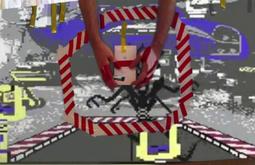
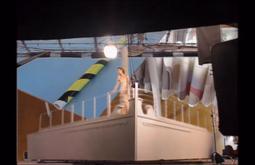
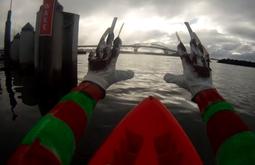
Video component of Eddie Clemens’ mixed media exhibition First Edition, Third Hand at Bowerbank Ninow, (2019).
The exhibition's central motif was Tu’i Malila, "a Madagascan radiated tortoise said to have been given to the Tongan royal family by Captain Cook in 1777, and owned by them until its death in 1965, when it was estimated to have been 188 years old. This animal is referenced in Philip K. Dick’s seminal 1968 science fiction novel, Do Androids Dream of Electric Sheep?, where it functions as a talisman for what the author perceived as the vanishing of authentic human experiences, such as empathy for animals, and their replacement by simulated equivalents."
"The video element of Clemens’ installation further explores the idea of the cyborg in the Pacific, making use of video footage from David Attenborough’s 1960 BBC documentary series, The People of Paradise. In this film, a scene of Attenborough feeding Tu’i Malila on the grounds of the Royal Palace in Nuku’alofa transitions into footage of coconut crabs, which Attenborough’s voice-over describes as resembling “ghastly, inanimate mechanical robot[s].” This strange juxtaposition speaks directly to the themes of Dick’s novel, pointing towards the interchangeability of organisms and mechanisms. In Clemens’ work, the idea of mechanical connectivity and system design become interleaved with biology and genetics; the Loc Line and Unistrut product groups that this installation employs become clades or species with their own strange agency and life. The segmented hoses and claw-like grippers of the Loc Line holders that Clemens has designed to support his books become like the limbs of coconut crabs, motile appendages that hover eerily on the boundary between machine and being."
The exhibition situated Tu’i Malila as the central node in an expansive thematic network.
"Navigating between history, fiction, technology and the everyday, Clemens works to ground the idea of the cyborg in the history of the Pacific. In this case, Clemens’ engagement with the material is carried out “third hand,” from the position of a viewer and researcher without direct access to the remains of the tortoise and the Tongan cultural context within which it is located. This installation is part of a larger research project investigating how the beguiling alternate realities of popular culture narratives, particularly science fiction films, intersect with and flavour our experience of the world.
To this end, Clemens has created an installation that re-imagines level 9, 10 Lorne Street as the Tyrell Corporation headquarters from Blade Runner, Ridley Scott’s 1982 film adaptation of Do Androids Dream of Electric Sheep?. He likens the sloping façade of the Lorne Towers building, constructed at the end of the 1970s, to the immense, pyramidal structure in Scott’s film. Clemens does this by way of a video projection that consists in part of a digital rendering of the inward-sloping window frames that are concealed by the walls of the gallery. This row of windows are depicted pierced by roving beams of light and reflections from water that reference the set design and lighting of the Tyrell boardroom scene in Blade Runner. For the exhibition opening, Clemens has arranged for a camera drone to shoot footage of the exterior of the building and approach the balcony, paralleling the famous effects shots of the “spinner” car landing at the Tyrell Headquarters in Scott’s film." - from an essay by Bowerbank Ninow (2019)
Installation Media:
Do Androids Dream of Electric Sheep?, Philip K Dick, US First Edition Hardcover, Published by Doubleday (1968)
Do Androids Dream of Electric Sheep?, Philip K Dick, Mass Market Paperback, First Edition, Published by Roc (1969)
Blade Runner, Original Screenplay (1980)
Various Loc-line components, Muller Electronics alligator clips, laser-cut and formed acrylic, CNC-machined and anodised aluminium, fasteners, Fibre-optic, Light engines, Various Unistrut components, Makerbot Replicator 3D printer, Panasonic digital Projector. Makerbot ABS filament (printed carapaces), Laser Kiwi Flag.