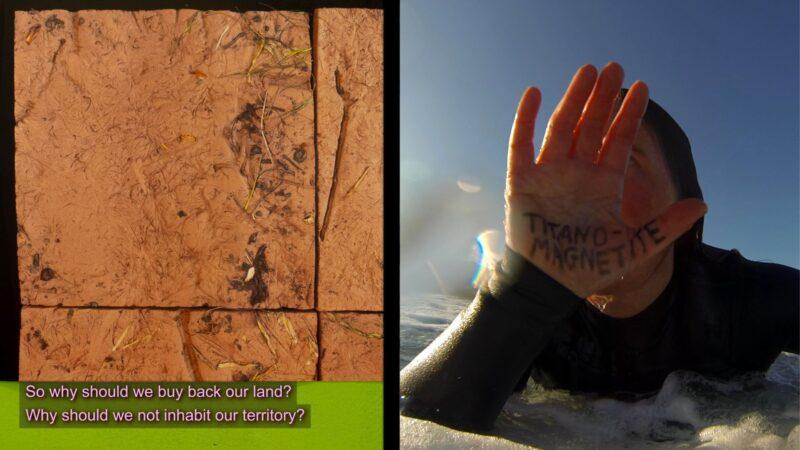
Ka Mua Ka Muri is a partnership between LUX Scotland and CIRCUIT. This podcast series brings together artists based in Scotland and Aotearoa to discuss shared interests in artist moving image practice. With support from The British Council and Connections through Culture.
List of Topics:
00:00: Introductions
01:30: Maria on language, colonial legacies, This Map of Affections as an act of resistance after Colonialism. Feminist focus, women’s stories and histories.
03:15: Maria on her background as a painter and the relationship with moving image, ideas of translation across artistic mediums.
04:10: Alex gives her mihi / introduction in te reo Māori, then in English discusses her Irish and Samoa family whakapapa / genealogy. Describes coming from a time-based background as an artist. Moving to Aotearoa from a Troubles context in Ireland. Discovery of surfing. Her Scottish whakapapa / genealogy and her descent from “inherited Unionist traditions”. Talks about her film Chapter and Verse (2005) which addresses rural experience of the Troubles.
07:10: Alex on the minerals in film technology. How to “minimise the harm and move to more sustainable ways of making community and understanding place”. Her interest in marine reserves. Histories of activism. What care looks like.
09.00: Maria on the origin of This Map of Affections. Working as a translator for a project bringing together activists from Brazil and Scotland. Land rights, finding common ground around topic of Colonial erasure. Affections as points of solidarity. Loss of rights to common land in Brazil. “You just have to pay attention and you can join up these dots”.
13:22: Alex on Deepwater Currents combining her political practice with the personal. Seabed mining proposals as environmental destruction. Art slowing us down to enable us to look at the issues. The personal adding subjectivity to counter authoritarian narrative structures. Her own status as “an uninvited guest in Aotearoa”, and that of her children. On first seabed mining proposals in Patea. Legal processes, communities fighting government. Art as quicker than legal processes.
17:30: Alex on the circulation of the thermohaline ocean current taking hundreds of years to travel the Earth. Respecting knowledge systems from local Hapu (sub-tribe communities).
19:50: Maria on developing the form of her film, and use of split screen. Making a map in her studio with collected ephemera. Going to the EU parliament to listen to hearings on the environmental impact of economic development, and being disappointed at the lack of response from the politicians. ‘Affections’ as motivating us to keep on going. Globalised effect of mineral extraction on local places. Maria on Alex’s film and how far you can see from a surfboard, from a human capacity versus the vast goals of mining extraction.
26:00: Alex on the genealogy of technological extraction, “the process is prepared to kill 100% of all living things”. The lack of engagement of corporate mining with local communities. The problem of individuals holding huge tracts of land. Alex on Maria’s film and the “green lairs”, rewilding that closes out local people and relational experience.
30:00: Maria on carbon credit schemes and sole landowners undertaking green capitalism on the island of Skye. On 'Fortress Conservation' - “Rewilding isn’t just about putting trees behind a fence”. On the biodiversity of the Amazon. On the book Calaban and the Witch (2004) by Silvia Federici. The transition from Feudalism into Capitalism. Land prices in Scotland increasing for carbon credit schemes. Maria agrees with Alex about centuries of history playing out in the present.
35:20: How to make films when mineral extraction is embedded in the tech and production processes? Alex on wanting to make a gentler imprint. Making at home. Using old tech. Relation between tech elements like batteries and the effect of Earth elements like land or water on their productivity. “Poetic disquiet”. “We need to slow down and be more local”.
38:20: Maria on seeing the toxic aspects of film-making technology. On the book Hospicing Modernity (2021) by Vanessa Machado de Oliveira - what are the thought patterns of modernity? Modernity is inherently violent. Holding that truth “unflinchingly”. “Art operates in a global value system as well”. “How does the work I make fit into the communities that I’m directly in?” Impossible entanglements.
41:30: Reaching audiences. The gallery, grassroots audiences who are engaged with the issues. Maria on working with activists on the production. Alex on the question of whether art or film can be part of relation building. Working with Māori. Working collaboratively. Co-authoring with Mana Whenua (Māori people who belong to the local). How can film support the spiritual agenda in those spaces? On listening as a Tauiwi person (someone resident in Aotearoa but born elsewhere). Taking guidance from others who hold environmental knowledge.
47:00 Alex on shooting underwater and the underwater ecology. Unlocking filmic form - working iteratively, showing the work to the public at certain points. When new relations emerge during the making, reopening the process. Using galleries to support Mana Whenua goals. On making the work over Covid.
50:30: ENDS
-circuit.jpg)
,-part-of-the-wastelands-(2024).-installation-view,-auckland-art-gallery-toi-o-tamaki,-2025.-image-courtesy-of-the-artist.jpg)