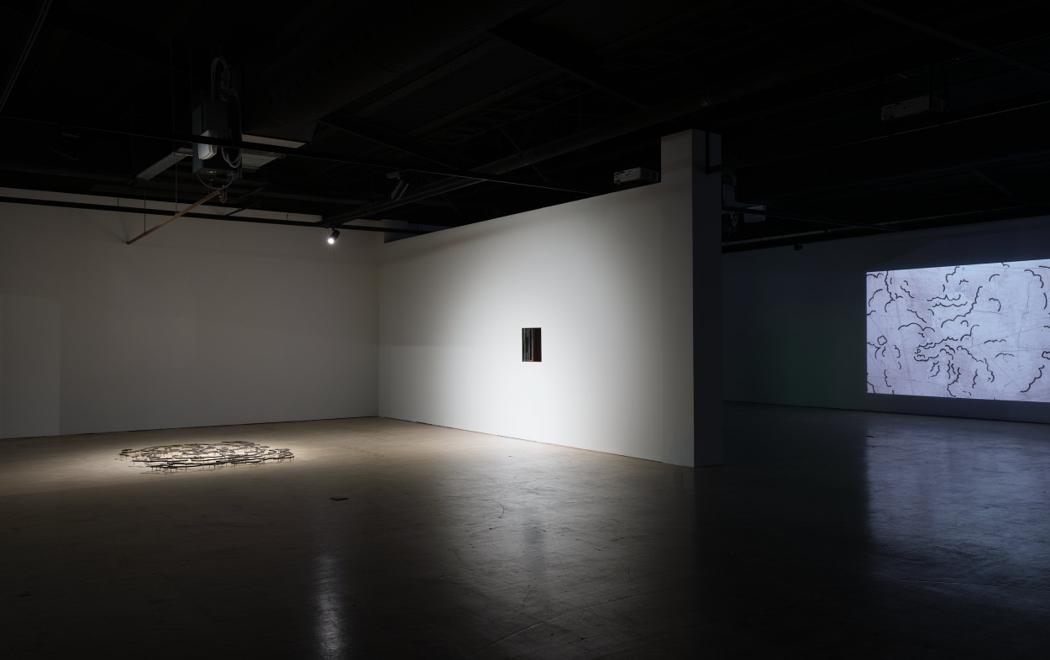
Is Lisa Reihana’s new film a masterclass in concise film making for the gallery setting? Perhaps. It certainly wears its manufacture lightly. Nothing strives, nothing glitches. It is an austere self-assured production. Thematically we can call the film a contemporary allegory that settles somewhere between myth and postcolonial redress. That said we can learn so much just by looking at the way the film’s made. Let’s begin simply by listing the skeletal mechanics of the film. These are its four obvious structural features:
1) It’s presented across a dual split screen
2) It focuses on a fable
3) The film is a perpetual loop
4) Reihana is not scared to use symbolism to condense plot.
There’s likely more structural features that we can add as we proceed but let’s start with these.
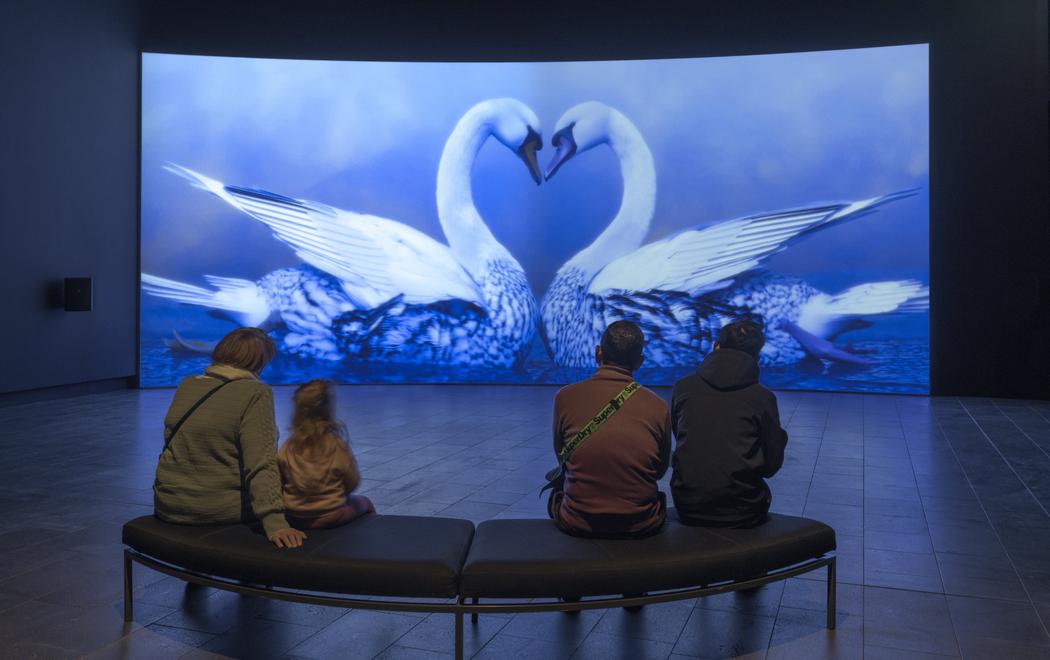
1) The split screen - This is a pretty normal strategy now in gallery videos. The split screen allows two things to happen at once. It also allows large panning shots to bleed across as panoramas. Reihana makes the most of both features. The duo screen keeps her pace tight but also expansive. It’s an immersive film that’s saturated in detail but also entirely open. She slightly arcs the spilt screens allowing her to run her panning shots into panoramas that grant the viewer breathing space. To soak up the narrative. But she’s also not afraid to break that allusion to allow multiple narratives to run at once. Often the film can feel fractal. Compositional.
2) Fable – Fables are an allegorical form of storytelling. That is, a basic story structure overlaps with a second order story. Characters, action and plot can be abstracted into themes, concepts or events. Fables are traditionally shorter forms of allegory that tend to exemplify an abstract moral thesis or principle of human behaviour. They are often transposed onto animals whose actions stand in for humans. The greedy pig, the crafty fox etc. Michael Stevenson has written a book on modern fables that’s worth consulting [1]. In Lisa Reihana’s case the story is a quasi- fable. A kaitiaki taniwha watches over a protagonist who’s caught in a perpetual loop of predatory abuses.
3) Perpetual loops are perfect for the gallery setting. You never have to worry about where the film starts. You can enter at any point and typically it will revolve around and around and around until you get the point.
4) The challenge with the perpetual loop is you watch the film over and over, gleaning the detail each time. Reihana knows this. She’s not scared to drop in what could be heavy handed symbolism in other formats. A numberplate embossed with the nomenclature “stealr”, a pompom necklace twirled around like a clock in reverse, a tattoo of keyhole... It all adds up. It helps in a film that’s only eleven minutes long. It extends the possibilities for allegory.
5) The thing that is hard to get past about Reihana’s work is how much of a great stylist she is. Think of the digital marae series. That kuia with her long long fingernails. Terrifying and yet wholly approachable. It’s the same here. Take her nightclub scene. It’s a wonder the Pacific Sisters didn’t provide the costumes. It’s a futurist fantasy. This is of course another bow to Reihana’s method. In a concise film stylistic choices are narrative choices.
,-2025-circuit.jpg)
Lisa Reihana, Aratohu (still), 2025. Two-channel UHD video, sound, colour; duration 11 min, 5 sec. Collection of Christchurch Art Gallery Te Puna o Waiwhetū, gift of the Christchurch Art Gallery Te Puna o Waiwhetū Foundation, purchased with the Together Endowment Fund, 2025.
Ok, So much for framework. What now?
1) We said it was a masterclass in film-making. What about the presentation. Dark room. Martino Camper “Circus” stools to sit on. Vaguely uncomfortable but you don’t notice. The film moves with pace. Its allegorical. You’re thinking from the outset. Piecing it together. You hunch forward. You look around. You feel like a pawn in a bigger game. Pieces being moved about. Just like the eight or so stools. It feels intentional. Another piece of choreography.
2) There’s this brilliant scene when our protagonist, Wairangi stumbles out of the club onto a stairwell. Her drinks been spiked. She’s over capacity. Swoony. The filmic lens is a blur and then quickly bought to attention by a stock figure. The well-meaning stranger. Solicitous but meaninglessly concerned. “Are you okay?”. When clearly nothing is. Wairangi takes one look and bats the pompom necklace the intruder is wearing. It spins in reverse. Around and around. It’s batted away. Like it’s futile but also like it’s out-of-control. Beyond comprehension. Beyond our capacity to intrude. To help. It’s the perfect answer to the solicitous, paternalistic offer of help. It won’t help. It cannot be reversed.
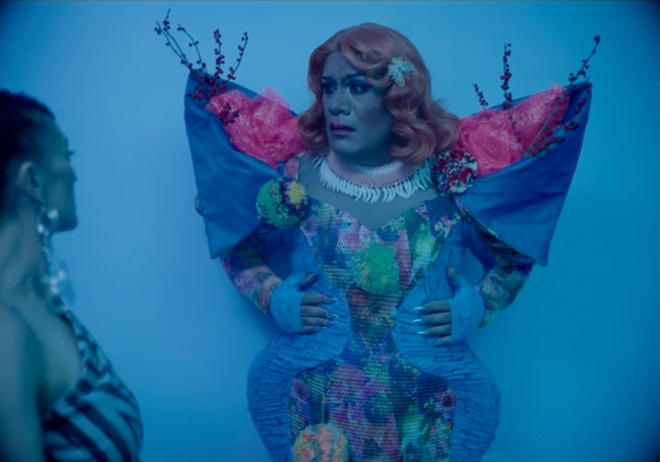
Lisa Reihana, Aratohu (detail), 2025. Two-channel UHD video, sound, colour; duration 11 min, 5 sec. Collection of Christchurch Art Gallery Te Puna o Waiwhetū, gift of the Christchurch Art Gallery Te Puna o Waiwhetū Foundation, purchased with the Together Endowment Fund, 2025.
Let’s start there. If this fable offers redemption what is it? Where is its moral through-line? There’s a clear dual moment in the film. Wairangi having been saved by the intrusion of the kaitiaki looks down to pick up a gift. It is an offering. But what is it? As she bends down to pick it up the film slurs, the background changes. Suddenly Wairangi is in a skid-row alley, bending down to pick up a cigarette butt. Her demeanour changes too. Suddenly she’s gaunt. She takes on the features of the junky. Her aspirations expire. It’s quite a confronting dichotomy. A yolking of the two. If you take this point as the fulcrum of the perpetual loop you find quite a traditional story. Let’s sketch it out quite crudely:
1) Wairangi is at a nightclub. It’s amazing. The costumes are incredible. It is futuristic in the way hope should be. Only it is an elaborate trap. Wairangi’s drink is spiked in an elaborate conspiratorial way. The bar tender supplies a charismatic agent with drinks. This pawn induces Wairangi. There is a predator waiting outside the club pretending to offer salvation. To whisk her away. His car’s numberplate reads “stealr”. There is a tattoo of a keyhole below his eye. He’s dressed like a white karaoke cowboy. Aged, weathered. Wizened.
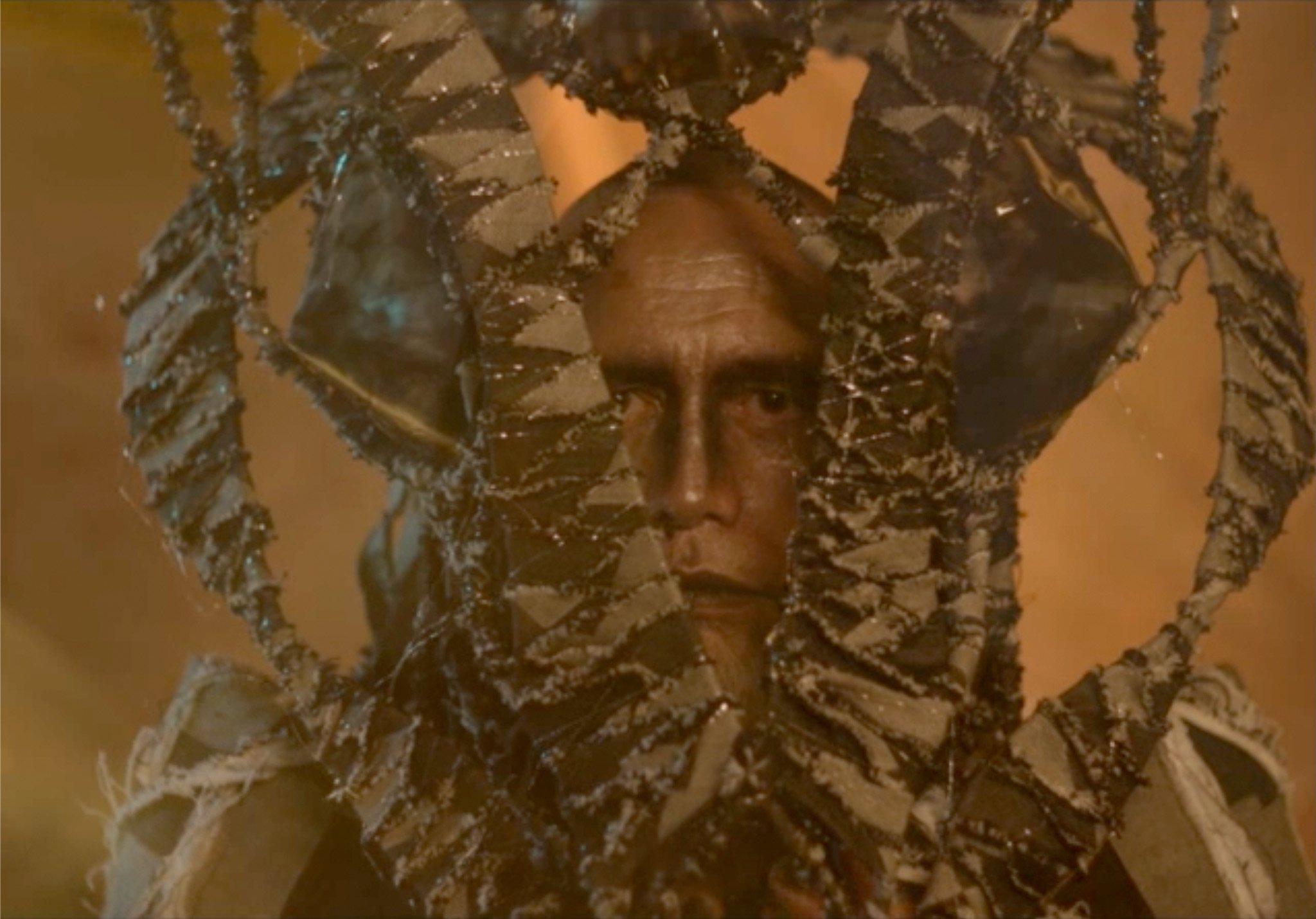
2) Taniwha as kaitiaki: When Wairangi falls victim to the drink spiking, the taniwha appears within the nightclub. He’s there but not in an obvious material way. He stands in the midst of the room. A physical thing but nobody pays any attention. He’s brooding. When Wairangi leaves down the stairs, as she bats that pompom, the taniwha rushes out of the room and down the stairs after her like a vapour trail. He pursues the white cowboy’s car. It’s like a scene out of David Lynch’s Lost Highway (1997). The film blurs, rushing by with a vertigo-inducing translucence.
3) Something happens on the highway. Offscreen. When Wairangi comes to, she’s sitting in an empty car staring out at a phantasmagoric scene. A coastal scene. A tree with exposed roots (again with the concise symbolism). It’s grown into a ridgeline that’s suffered erosion. A tree grows up as well as down. The tree is alit with an iridescence that hints at the otherworldly. Wairangi is intrigued. She follows the thread. She’s compelled. Drawn in. It seems to be the birth scene of a taniwha or at least Wairangi’s acknowledgement of them. She comes face to face, kanohi ki te kanohi. An exchange of breath, a gift is offered. A warning. “Kia tupato!”. And then the feather/leaf drops to the ground and Wairangi resplendent in hope bends to pick up this indeterminate gift.
Kua takoto te mānuka: how else do you read this scene? The challenge has been laid down. Wairangi bends to pick up the gift and is suddenly thrust into the skid-row alley. Her demeanour changes. She’s no longer the bright-young-thing. She’s weathered, she’s worn, she’s depleted. The alley is a nightmarish scenario of junkie behaviour. Squalid living. You start to wonder if the whole thing is just an elaborate dream. A junkie’s fantasy. Before the whole film again picks up pace and Wairangi, dragging away on this cigarette, stumbles back into the nightclub and transforms again. Stuck again in the perpetual loop that cannot be batted away.
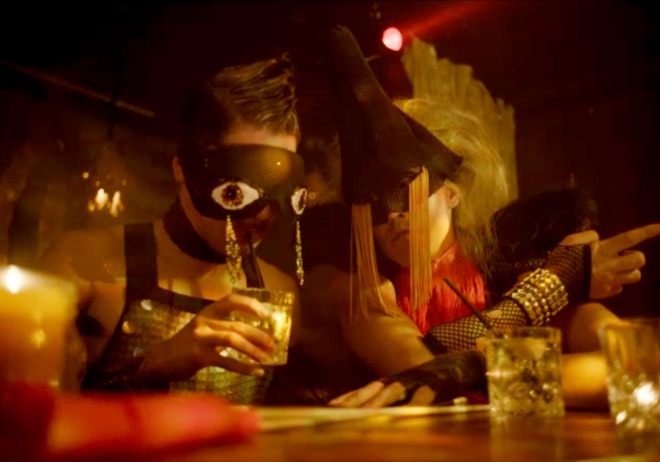
Lisa Reihana, Aratohu (detail), 2025. Two-channel UHD video, sound, colour; duration 11 min, 5 sec. Collection of Christchurch Art Gallery Te Puna o Waiwhetū, gift of the Christchurch Art Gallery Te Puna o Waiwhetū Foundation, purchased with the Together Endowment Fund, 2025.
Like we said, the film is allegorical. It can be readily overlaid onto a familiar colonial narrative. The structural racism that props up the proprietorial invective of New Zealand is through and through apparent. The white cowboy. The predatory practices of abuse. An induced sweetener and a poverty cycle that traps an adjacent population as exploitable mass. But what is also allegorically apparent in Reihana’s film is the pastoral Māori yolking of this narrative that Witi Ihimaera complained so bitterly about. The redemption of tradition, the tree that grows both ways. It’s here that Reihana offers something new. Her throughline is less a simple allegory of abuse and its remedy or redemption in traditional ancestral practices than a highlighting of just how readily exploitable that narrative is too. The tattoo keyhole on our white settler is pertinent here. Suddenly the drink spiking looks less predatory and more like an elaborate set-up. Why do all the concoctions look so similar? The spiked drink. The taniwha eggs. These libations seem less predatory intoxicants the more they become phantasmagoric openers. They break apart another world. Such is the hope or promise of the mingled futurism of Reihana’s club scene. Which has always been the allure of the club. As that zone of inhibition. It’s like the beach or the costal scene, not just a zone of contact but a liminal site of interchange. In the locus of such fluidity, more and more, life is defined by articulation, not negation. One has to move with intent. You hold the key.
There’s another scene within Reihana’s allegorical mélange that makes sense of this. In the club, Reihana pans over an older Pākeha woman who is making out with a young Māori boy on a couch. At first this scene seems entirely exploitative. The woman’s gloves are off. They’re draped over her shoulder. The metaphor seems brazen. It seems predatory. Incubus like. She consumes the young. But what if those gloves are off in a different way. What if she refuses her puppetry. The gloves are white. She’s taken them off, loosened herself of those strictures. Willing herself to be lost in the hybrid futurism of the club, whose tempo is so clearly Māori. Perhaps, but like the tattoo on the karaoke cowboy’s face similarly suggests, the answer isn’t to be found in the benevolence of the Pākeha but in the unravelling of their predatory guile through sheer indifference. That’s the warning. That’s Reihana’s wero.