CIRCUIT’s 2026 Matariki commission frames Matariki as something shared, connecting people across Aotearoa in a way that honours difference rather than flattening it. Anahera Totoro’s Tika? (2026) sits comfortably within this frame. Grounded in whakapapa, Tika? is subtle and layered in meaning. Its pared-back visual style allows room for interpretation. The mahi does not take itself too seriously, instead asking to be met with openness and generosity, and giving us permission to think about Matariki anew, in a way that feels humble, relatable, and quietly mischievous.
The title Tika? is doing important work. It begins as a question, asking whether something is right, but also whether it is in right relation. That subtle difference gives the mahi its charge. The work suggests that tika might be understood through intention, and attentiveness instead of fixed. In that sense, the question in the title becomes a way into the work’s deeper meaning.
For twenty-five years I have been creating mahi and writing about the ancestral ceremonies and knowledge surrounding Matariki. Gratefully, each year more mātauranga becomes accessible to the wider public. When I first began making mahi toi specifically for Matariki exhibitions, it often felt like an annual performative act by institutions, a box-ticking exercise. I remember whānau members saying, “What’s Matariki? I’ve never heard of that before.” At the time, it echoed the commentary around Te Tiriti, when people would say, “Nobody cares about it south of Auckland.” As tangata whenua living through these times of political injustice, it is easy to feel as though we are fighting a never-ending battle to reclaim our mana motuhake. And yet, in relation to Matariki, we have made enormous strides, more people and more cultures across the motu celebrate this time with us. Many conversations I have had about this time carry a deep gratitude for the research of Dr Rangi Matamua, who continues to expand our understanding of the stars and the mātauranga of this season according to our tūpuna and astronomy. In this sense, his mahi opens access back to our tūpuna. However attuned we may try to be with Te Taiao, it is not possible to inhabit that world in quite the same way.
The first scene in Tika? activates the whakapapa of Matariki, especially the story of Ngā Mata o te Ariki Tāwhirimātea [1]. In this particular creation narrative, Tāwhirimātea tears out his eyes and casts them into the sky, they become the constellations that guide us. As with all creation stories, it is violent and extreme, there is great sacrifice – therefore, from it emerged the ceremonial practices that illustrated our gratitude to the Atua, for giving us the means to navigate at night, and the knowledge for survival. Matariki was observed: remembered, and acknowledged by our tupuna as part of daily life and death cycles. Hautapu is the ceremony of feeding the stars, the scale of the creation story is answered by the scale of the ceremony. Hau (vital essence, wind, air, breath) Tapu (sacred, restricted, forbidden, set apart). Traditionally, an umu kohukohu whetū, was used to cook kai, and when the umu are uncovered, the steam rises through the air with karakia and waiata. In doing so the stars are acknowledged and the connection is sustained. The ritual is structured, but its meaning comes through intention, what matters is not performance, but the care with which the act is carried out. That, I think, is the thread that most strongly connects tikanga and Anahera’s artistic practice. In both, intention is fundamental. It is what gives the act its ethical and relational force.
‘In the late afternoon
they are what defines the light
and space
created through
separation
As unexpected, unplanned, imperfect
Space
opens up
and is left to be’
- Hana Buchanan, excerpt from the poem He Whetū Kōkōwai [2]
Manawhenua writer and poet Hana Buchanan’s poem, He Whetū Kōkōwai, gives language to becoming. Its tenderness lies in the way it holds creation as something luminous, something that opens up within the everyday, through “the late-afternoon light on inside walls.” As we read, we are placed between the creation story of the world and the creation stories that play out in our homes. That movement sits alongside Tika?, where the stars are not fixed symbols but living forms made visible through patient acts of making. Anahera’s mahi suggests that creation itself can be a form of ceremony when it is grounded in that kind of attention.
Anahera Totoro, Tika? (2026)
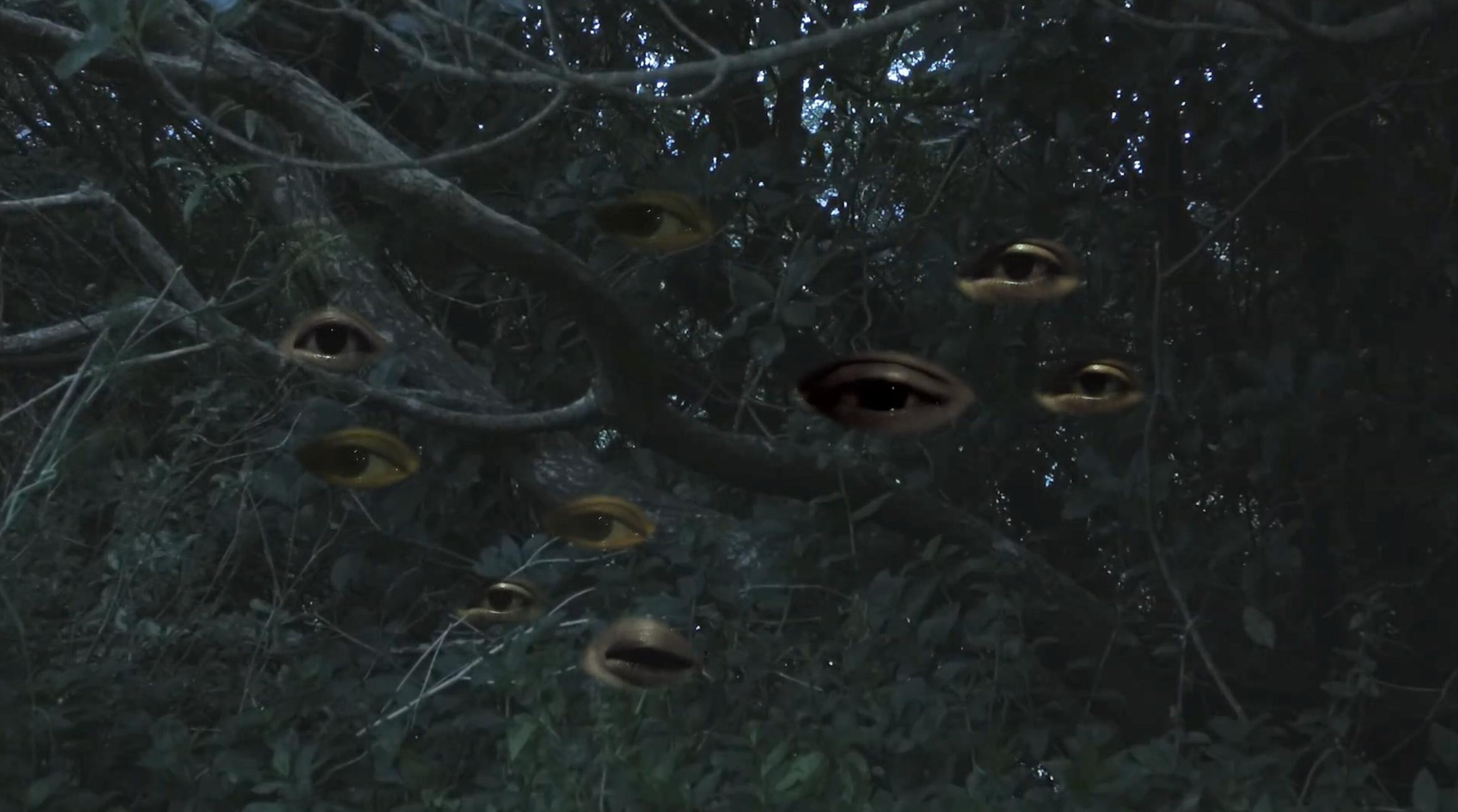
Tika? has its own visual poetic rhythm and cadence, the first scene sets this tone beautifully, nine eyes look directly at the lens from within the ngahere. The image is intimate and a little uncanny. The eyes belong to the artist, her whānau and friends, and the effect is one of being quietly drawn into a shared space of looking. Acknowledging the pūrākau, Anahera’s joyful sense of humour plays a little too. I find myself examining the eyes for emotion, wondering whether each whetū belies its own disposition. An earth-bound constellation framed by trees in a half light, the image recalls the star cluster without illustrating the magnitude of the universe. I imagine the stars have a sense of humour and delight in this form of recognition. As I ponder this thought, light flickers through the branches, and the sound of the kōauau, (made by the artist when she was young), gives the scene a breath-like intimacy. The sense of hau breath, wind, life force threads through the work, linking each scene to the next and carrying a quiet human presence across the film. It is as though the artist is taking us on a journey shaped by her own breath, personalising the path through the work without ever losing its openness. This is what gives the work its living current.
From there, the film moves outward into familiar spaces of daily life. Thinking about the work installed on Mason’s screen, Anahera has considered how it will be encountered by people walking through the space, with the stars held in constant view as a familiar constellation that continues to meet the moving viewer. The constellation is again made human, and accessible by clay stars, hand-formed and suspended on hāngī string. Literally hanging out, they appear nonchalant suspended outside dairies and takeaway shops in Lyall Bay and Brooklyn. These are familiar places of quick kai and quick errands, yet Anahera treats them as sites where Matariki can be encountered. The effect is generous: rather than separating the sacred from the everyday, this mahi lets them sit together. In doing so, it also reflects Anahera’s desire that the work remain open and accessible across cultures, offering Matariki and ceremony as something approachable through careful humility. These gestures are subtle, as the stars are not fed through steam rising from earth ovens, but through placement in our everyday life and the act of making itself. Anahera’s use of clay and string recalls the material processes of hāngī, while her use of video and layering of symbols translates whakapapa and pūrākau into digital form. This translation speaks to a broader condition, as many tangata whenua now live at a distance from their hapū and their tūrangawaewae. This is where the work’s accessibility becomes most interesting: it allows ritual to be lived within the conditions many people already inhabit. Urban streets, suburban shopfronts, local parks, and fences become part of the work’s ceremonial landscape. In this way, Tika? shows that cultural practice remains alive in the present tense, even as it is dispersed and adapted.

Anahera Totoro, Studio Collage (2026)
On May 26th, I visited Anahera in her studio. During our conversation, she talked about her mahi, her creative process, accessible rituals, and connecting with whānau. In her small, well-lit studio, Anahera welcomed me surrounded by her creations, tools, inspiration and a painting of her koro that she has been working on. Swirling deep Prussian blue with white stars, a central figure materialises through the fluidity of kōwhaiwhai. A representation of her koro, that felt more Pou, than liquid or paint. She told me that she has been working on it for years. This slow, handmade process is part of the charm of Anahera’s mahi: she works instinctively, when it feels right, and because of this the result carries an intrinsic sense of joy and effortlessness. Anahera is currently working on several video and clay stop-motion animation projects. Little idols, hints, and remnants of the imaginative worlds she creates sit on shelves and walls, waiting to ‘be’ again. It reminds me of the story of Pinocchio, though what fascinated me as a child was not the puppet coming to life, but Geppetto’s workshop; the tools lining the walls more than the toys. I wanted a workshop like that more than anything. The magic, I think, lies in the maker’s hands. Imagination and inspiration feed the hands. Claymation itself echoes ritual, with each small movement holding the same patience and care. If we think about the layers of whakapapa and the tikanga of mahi toi, whakairo, tā moko, and raranga, then breathing life into these materials becomes a way of allowing a creation its own life and autonomy. In this sense, the creative act is about enhancing life and letting it go.
Anahera also spoke about creating Tika? and how she wanted to imbue the mahi with a narrative of accessible rituals, highlighting the ease with which whānau can come together over kai and spend time together. Within the urban environment, space for an umu is a luxury, especially when many of us live in crowded high-rise buildings. Travelling home to our tūrangawaewae is also a luxury in a time of rising costs and long distances, so activating local and familiar sites became central to the mahi.
Another site
recommends giving back
to waterways today, so I’ll visit
Kākānui beach with a bag
and clear litter from there.
Better have a coffee
And play my kōauau
Slowly.
- Robert Sullivan excerpt from his poem Ariroa: ‘The Maramataka website today ((Low Energy))) [3]
In the Robert Sullivans poem Ariroa: The Maramataka website today (2024), he illustrates the way ceremony can be sustained through modest daily and attentive acts. By the final scene of Tika?, when the clay stars rest against a fence in a local park, framed by earth, stone, and trees, it feels like we have come full circle. The stars of Tika? are more than representations, here, they are a breath of life given to handmade objects, their ‘being’ embodies the act of making and that closeness gives Tika? its tenderness, it feels like an offering. This is where the mahi opens into something larger. Tika? humbly reminds us that cultural practice remains alive through adaptation, and meaningfully allows us to see it in our daily surroundings.
In this way, Tika? inhabits Te Whanganui-a-Tara, our city, and Matariki as localised ceremony, illustrating that continuity endures through the recognition and intention we carry forward. What is enough to nourish the stars? Enough might be acknowledgement. Enough might be gratitude. Enough might be intention. Enough might be spending time with those you love. Enough might be a single act of making. Enough might be some or all of these things, and it may even be a little uncanny.