I first heard about Matike Mai only recently, in March. Matike Mai is a visionary project towards constitutional transformation in Aotearoa. It began in 2011 as a research project and consultation process with Iwi and Hapū conducted by The Working Group on Constitutional Transformation, led by the late Moana Jackson. The project resulted in a 2016 report on findings, with wānanga and mahi continuing on today. I learnt about the project earlier this year when, as a member of Asians Supporting Tino Rangatiratanga (ASTR) in Ōtautahi, I had helped organise a gathering. ASTR is an organisation aimed towards educating our tauiwi communities about Te Tiriti, and the gathering was intended as a political energiser ahead of this year’s election. Our speakers at the wānanga were Kirsty Fong, co-founder of ASTR and a Te Tiriti o Waitangi facilitator, and Kahurangi Carter, Green MP, now campaigning for Christchurch Central. Kirsty led a visualisation exercise which stems from the Matike Mai kaupapa. We were prompted to use our senses and dream of the future we want to embody, acknowledging that the values we imagine for ourselves are often shared with others regardless of background or political alignment.
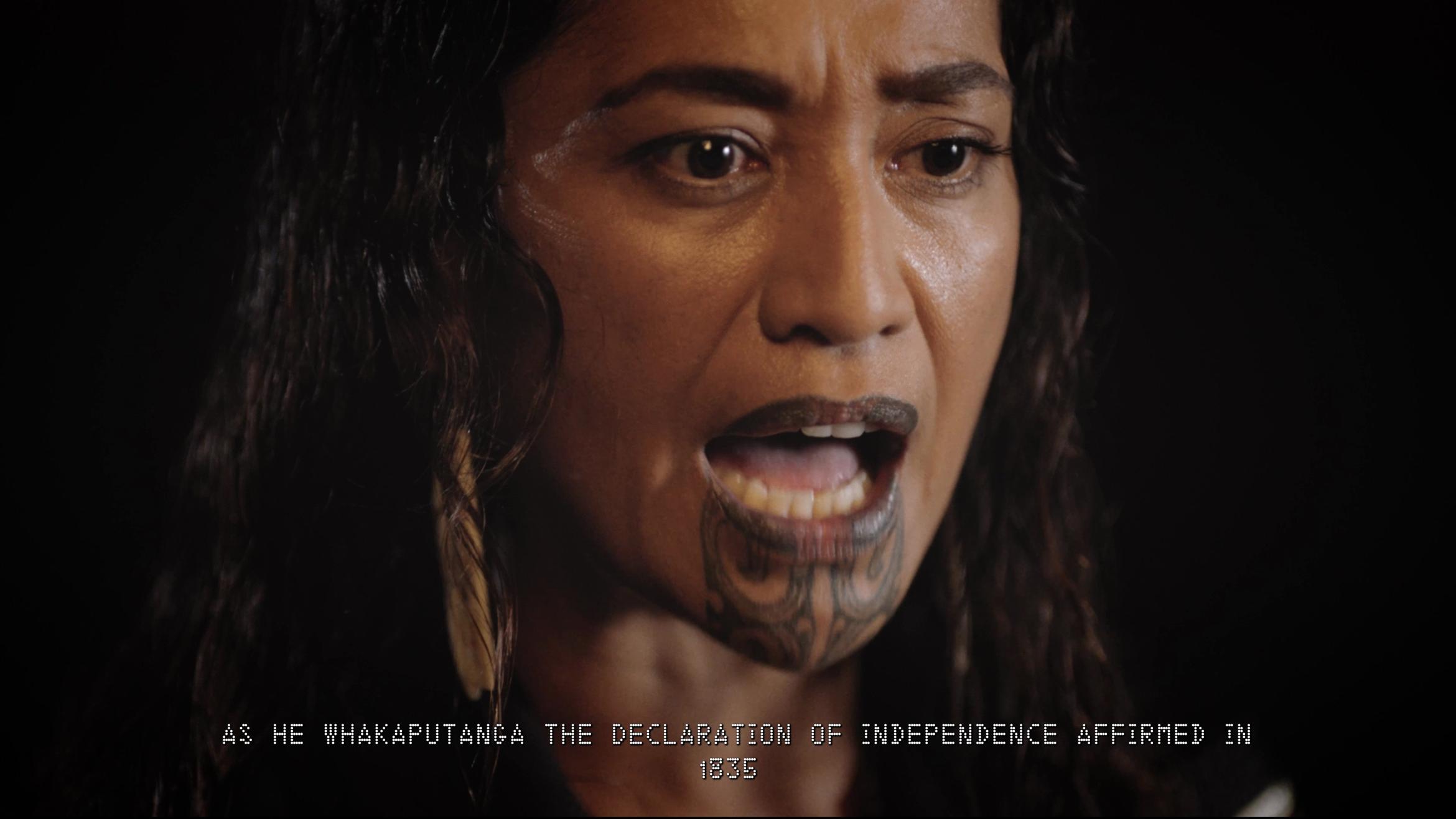
Showing from 18 April – 31 May at the Physics Room in Ōtautahi, Luke Willis Thompson's B42040A1A1A was an installation comprising two major moving image artworks developed over the past three years. The opening weekend began with an artist talk from Thompson which outlined the projects’ relationships to Matike Mai. Whakamoemoeā (2024), set in 2040 on 6 February casts Oriini Kaipara as some future version of herself, briefing the public on the constitutional transformation which has been enacted as the outcome of Matike Mai. Soro (2025) is set in 2031, 10 years after Jacinda Ardern’s 2021 Dawn Raids Apology and is a redress of this apology and serves as a foreign policy for Matike Mai. Soro is performed in New Zealand Sign Language (NZSL) by Alan Wendt, a Senior Interpreter for Deaf Aotearoa.
About the title, the artist states frankly: “It’s a bit stupid actually but the B4A1A1A is what’s called the ‘Polynesian motif’ and it's a kind of genetic tag that is present in the genetic map of everybody from Madagascar to Aotearoa.” [1] But the title of Thompson’s show has an added sequence, B42040A1A1A — before twenty-forty. Because that will be 200 years since the signing of Te Tiriti o Waitangi and because, it is when Matike Mai will be implemented. [2] Merged together, they resemble a genetically coded activation date.[3]
Whakamoemoeā opens with a black screen and the sound of bird call and kāranga. Next, the image of Oriini Kaipara standing wearing a formal korowai, Te Whare Rūnanga is visible in the background. Throughout the work, the camera shifts between Kaipara’s face in close up and a comfortable mid shot with the whare slightly out of focus in the background. The sky is dark, it is before dawn. Kaipara performs her speech in te reo Māori while I read from the English subtitles. In its staging, camera, and cadence Whakamoemoeā is believable as the news broadcast it has been designed to mimic. It is like a prophecy and a challenge, both. Kaipara declares the beginning of the new plurinational democracy: “Unilateral Crown power has finally ended.”
The Matike Mai report describes terms for different power ‘spheres’ (in Whakamoemoeā they are referred to as ‘whare’): the Rangatiratanga sphere is made up of an Iwi and Hapū assembly; the Kāwanatanga sphere is the Crown in Parliament; and where both groups come together to make joint decisions is the Relational sphere. The report puts forward six suggested governance models, each with different configurations of Iwi, Hapū and Crown assemblies and representation.
In the video, Kaipara announces: “This year we finally abolished the Westminster parliamentary model, and instead established a bicameral system structured by two separate houses of governance,” the Kāwanatanga in Parliament and the Rangatiratanga Whare with no fixed location, both holding parliamentary sovereignty. “How each tribe determines their political representation in the Rangatiratanga Whare is a matter for their own people.” The bicameral model does not include a relational sphere. [4] It is notable that Thompson chose to represent this future rather than one of several other three-sphere and multi-sphere possibilities put forward in the report. Where the two Whare or spheres inevitably come together perhaps needs no model, as the script reminds us how Māori and the Crown have “worked together and built treaties and alliances for centuries”. Thompson describes the coming together as a “consensual democracy”.[5]
In the gallery the videos screen one after the other. Soro is silent and shot on 35mm black and white film. Benches in rows, I think of Church pews. In the artist talk Thompson mentions that the script of Soro is “very Christian inflected”. The title comes from a part of the traditional Fijian justice system which accounts for wrongdoing and calls for reparations. It is a homonym of sorrow, the sentiment expressed throughout Ardern’s apology. In 2021, on behalf of the government, she promised to reform the immigration policy, but in 2023 dawn raids were still taking place and so the apology was barren.[6]
As I do not know NZSL, watching this work I once again come to the content of this address by reading subtitles. Set in 2031, we see Wendt interpret for an implied politician who remains out of view. Signing, Wendt leads us through the announcement of expansive changes to Aotearoa’s foreign policy which now welcomes an increasing Pacific whānau of climate refugees. The future government aims “to re-strengthen the deep whakapapa bonds of Māori and Pacific Peoples” and towards free, borderless movement within the Pacific. “Our first step will be to establish a Tiriti-based immigration model that adheres to the tenets of manaakitanga. We will work with our Pacific neighbours to introduce a humanitarian visa for all peoples who have been displaced by the climate crisis.” These are themes that Whakamoemoeā also addresses — for Soro it is the focus. Thompson envisioned Soro to be the foreign policy on the road to Matike Mai.[7]
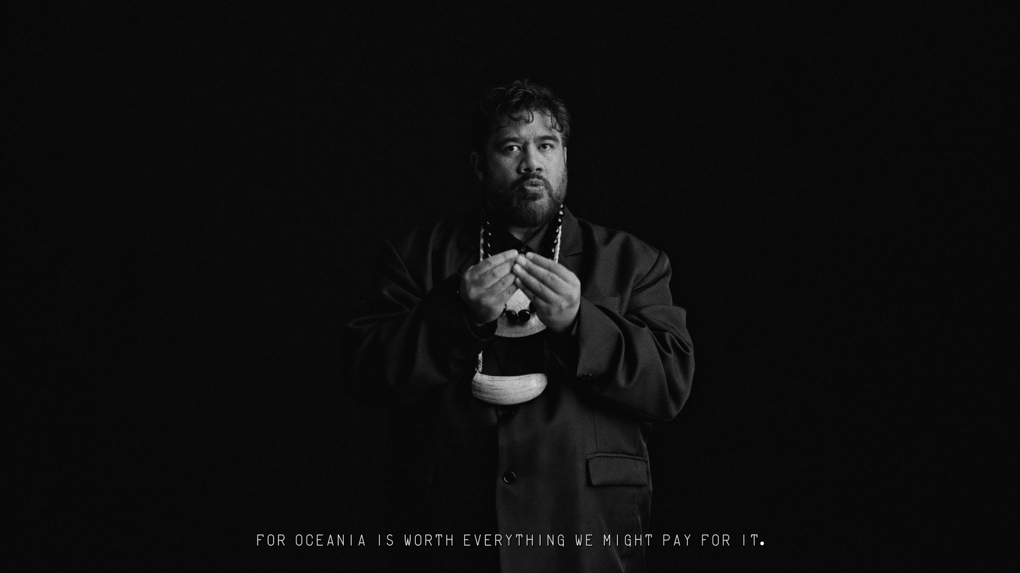
Luke Willis Thompson, Soro (2026)
This film leans into an aesthetic treatment of the figure compared with the more utilitarian broadcast of Kaipara in Whakamoemoeā. Silence accentuates the image; dramatic lighting on Wendt, signing and pausing. The shot is not framed in a way you would expect for watching an interpreter, nor is it static; though still ‘readable’, the camera is offset to the gesturing body, often hovering unsettled. In contrast to Whakamoemoeā, it is not clear where we as the audience are supposed to be.
Wendt says in an interview that an interpreter’s role is to act as an authentic bridge from the speaker to the receiver, to take on mannerisms without making a caricature.[8] In Soro, Wendt's gestures are expressive and infer some of the pain of the historical injustices they describe, and I wonder if he is showing more of his own character here, or taking on the manner of the artist or someone imagined. Thompson offers: “I think Alan's performance is full of grace and full of sorrow, but also I’m apologising too, for something in this work somehow.” [9] He doesn’t say what he is apologising for … Thompson is a Fijian New Zealander whose father was directly affected by the Dawn Raids. He received project funding for Soro from the Niu Dawn Funding Initiative, part of Jacinda Ardern's reparations package after the apology.[10] In Soro, in a way that appears inevitable, the artist amalgamates ideas of reparation, of sorrow and of the complex emotions and cognitive pathways involved in feeling sorry.
Considering the focus on Wendt delivering this speech, I wonder how it is perceived for hearing-impaired folk whose eyes are on an interpreter perhaps more than on the Prime Minister speaking. In Wendt’s case, surely the visual association is there, of a Sāmoan New Zealander sharing the words of the PM to the public. Here, Thompson is deliberately blending speculative fiction with images from our present in casting public figures such as Kaipara (a broadcaster at the time of filming and now Te Pāti Māori MP), and Wendt, whose presence next to Ardern was as common as the COVID-19 daily press briefings. Familiar political spokespeople from our homes and screens, figures from such vulnerable and emotive times as the pandemic and the 2019 Christchurch mosque attack. Thompson states that he aims to exploit our memory: “I wanted to hide my film within your memory to make it more real”.[11] Here, the close rub of dream and reality primes us for the kind of futuring Matike Mai asks of us.
The Matike Mai report took into account the voices of everyone who attended the more that 252 hui across the motu. “All of the hui were recorded and transcribed and this Report is a synthesis of those transcripts as well as the written submissions and completed surveys.” [12] Likewise, Whakamoemoeā took a polyphonic approach to script-writing, first drafted in English by Thompson and Tu Neill “who collaged a great number of speeches and texts from Moana Jackson and members of the Working Group” before being rewritten in te reo Māori by writer Aniwa Nicholas. As part of this translation process Thompson and Neill explained their thinking “behind each sentence”. [13] The text was then given to Kaipara who also made changes, before being passed on to Margaret Mutu to “OK the political content from the perspective of Matike Mai”, and to Quinton Hita for linguistic expertise. [14]
Specifically, Thompson says, they avoided transliteration of political terms. Further, there is a deliberate treatment of the subtitles, for which the same level of attention and care was taken. And this is how it will be, and how it was intended at the time of the signing of Te Tiriti o Waitangi, that languages hold onto their nuances, while good faith and shared values — or as Kaipara says, “shared fate” — bridge the gaps which language cannot. As the Matike Mai report reminds us, the “fact that there is no word for ‘cede’ in te reo is not a linguistic shortcoming but an indication that to even contemplate giving away mana would have been legally impossible, culturally incomprehensible, and politically and constitutionally untenable.”[15]
These works handle time as if it were plastic. These things of the future like a political address from Kaipara or sign-interpretation by Wendt, are also saturating our present and past. As a viewer I feel the bizarre sensation of being held in an energetic limbo. Watching these works I get the uncanny sense of both hope and relief. Although this hope is tempered by some scepticism, there is an energy in the feeling, and a call to action where there is much work still to do. Yet at the same time I feel relief as if the work is already done and I can believe that this is our future which I am seeing now, like a prophecy.
In a similar way we can think of the Matike Mai report not only as a contemporary document but as a working document. I mean that in the sense that the work of the report is being played out, enacted, across the motu by many people, including tauiwi, pākeha, tangata tiriti and Māori, towards the goal of 2040, 14 years from now. We are on the road, and we are there, and there is much work to do, and we are endlessly spinning and turning towards the past. Aotearoa’s general election will take place on 7 November 2026. If you haven’t already, enrol to vote before 25 October 2026 to be eligible this year. Dream into the future that you want to embody.