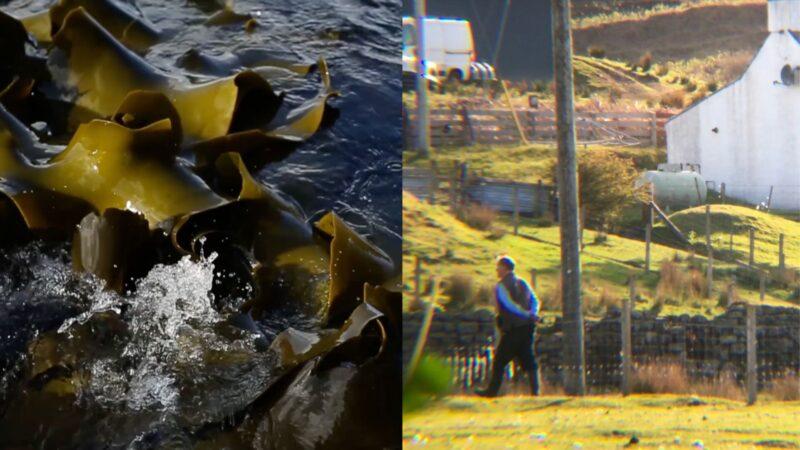
Ka Mua Ka Muri is a partnership between LUX Scotland and CIRCUIT. This podcast series brings together artists based in Scotland and Aotearoa to discuss shared interests in artist moving image practice. With support from The British Council and Connections through Culture.
For the final episode of Ka Mua Ka Muri – Walking Backwards Into the Future host David Upton (LUX Scotland) speaks with Sandy Wakefield (NZ) and Andrew Black (UK) about using the moving image to affirm ancestral connections to land and home. They discuss one film by each artist; Sandy's Nakunaku (2020) set on Rakiura / Stewart Island and Andrew’s Dàn Fianais (2022), set on the Isle of Skye. In the face of tourism and rapid commercial development, both islands still retain a deep sense of place which is held in the songs, stories and heritage of local people, which in turn infuses the two films under discussion.
Nakunaku and Dàn Fianais streamed on LUX Scotland 23 March - 5 April 2026. Nakunaku can be watched on CIRCUIT here.
00:00 Introduction by David Upton (LUX Scotland)
1:30: Sandy on her personal connection to Rakiura / Stewart Island; the Māori and Scottish history of the island.
2.45: Andrew on the Isle of Skye as a contemporary tourist destination. Andrew’s own history of working on crofts on Skye.
4.09: Sandy on Nakunaku’s themes; the history of Māori women and Scottish men on the island; her family ties to the island, despite having been absent for 5 generations. “(the film is) about my personal reconnection to this place by visiting sites”. Difficulty of visiting Rakiura for economic and access reasons.
7.40: on origins of Dàn Fianais - responding to an open call for a community film looking at climate crisis. Project theme changed “drastically” but guided by local people, “essential precarity of life in the islands” language, agriculture, folklore, history, and “a document of the moment”. “A lot of the issues discussed have intensified”. “told by the local people in their own terms” question of whether it makes sense to people who don’t work in Skye… “in the local is the universal”
10:32: On the singing in Dàn Fianais, the structure of the film as a series of short stories and visits (in the manner of the Cailleach) broken up by song
12:30: Importance of passing down generational knowledge, and risk of losing it. Sandy - “I’m trying to just stand and… essentially breathe the air there”. Sandy on the decisions just to speak to the women on Rakiura, and the islands history of sheltering women. The lack of a Māori welcome at the port and an identifiable Māori presence when you first arrive. Impact of tourism. Interviewing women about how they keep their Māori identity in that place.
16:03: Andrew on passing down intergenerational knowledge in Dàn Fianais. Gravitating towards old people, who hold knowledge of cultural reference points sometimes obscured by universal American/English media and culture... "not the stuff in their immediate vicinity”. Difficulty of “making the case” for ancestral knowledge when there's a belief it sometimes come with socially conservative attitudes that we don’t want to replicate. "I i think there’s a lot of nuance that’s not given enough space”. Skye has become a leisure environment for people with excess money, there isn’t an economy that supports people outside the middle classes.
20:00: Andrew on searching #Skye on Instagram and seeing Skye scenery with no sense of cultural life. In Dàn Fianais there's no English accents, “you have dig pretty to meet someone on Skye who doesn’t have an English accent... it might be a bit naive to edit a certain reality out of the film… but I felt it was important to have our version of the place…”
22:00: David notes resistance in both works to romanticising the landscape. Sandy on her initial hope that the film would “make connections and be empowering”. Feeling grief after conversations. On deliberately obscuring some of the women’s conversations in the film.
25:00: David asks Andrew about images of a dead lamb and a cairn (human made pile of stones). Andrew discusses the romanticisation of the Skye landscape, “its a very topographically complicated place… extremely intense landforms..a real gift for people who want to depict landscape...I want to deliberately refuse it”. Shooting on low res video and phones, as a strategy to counter the romantic landscape. Being unable to visit the island during the production process, asking other to shoot video on behalf, and this being liberating - “the collective agency”. Focusing on small things, interiors of peoples houses, the inside of a car. The film speaking to people who "have a social life there....it felt important not to stage any conversations in places that were filmic”.
30:00: Sound design. Sandy on her background as sound recordist and influence of BBC radiophonic workshop. She notes Delia Derbyshire and others. Presenting the film with a live manipulated soundtrack. Recording the birds. Rakiura birdlife as a the sound of pre-Colonial Aotearoa. Significance of birds in ancestral Māori culture for food. Decision not to include the Titi bird sound, although it is the dominant bird on the Island, but it belongs to Māori custom Sandy is not part of.
33:45: Andrew on the Soundtrack for Dàn Fianais. Traditional Music and song which tells stories of histories of resistance, immigration. Link with contemporary concerns. Gallic history. Assistance of local musician to get permission to include older songs. Revival of local traditional music on Skye today. Responds to David’s suggestion that the soundtrack is "anti-climactic" - "a device to keep it conversational".
38:00: Sandy on experimental approaches to sound in the film, using German tourist pronunciation guides, sound of canoes, sampling Pasifika drumming.
40:30: Andrew on the use of “pumping music” in Sandy’s film as a propulsive force.
42:00: How do you make interviewees comfortable to share their stories on camera? Sandy on not using a camera, only recording audio. Interviewing women in their workplaces. Māori culture as oral tradition. Andrew on selection of interviewees, building trust and being up front about his own political opinions. Being challenged on his opinions by one interviewee. Working in a small community, addressing contentious topics “going on the public record… was a big ask for some folk”.
49:00: How do you as artists feel about working to maintain living transmission of ancestral knowledge? Sandy on ‘Ka Mua Ka Muri - Walking Back into the Future’ as a universal concept. Language reclamation. On the need for historical education. Accessibility to galleries, cinema and “our own Māori culture”. "I would like to think I am contributing to contemporary oral tradition”.
53:00: Andrew on metaphor of walking backwards into the future in the writing of Alastair Macintyre. Idea of capitalist progress as feeling inevitable versus idea of time in various cultures as cyclical. Strengthening of Gallic culture and language. Issue of this education not necessarily holding the sum of ancestral knowledge which is lost or obscured. Dàn Fianais as “an attempt to give space to a certain demographic of the island should be listened to”.
59:55: Shared affections in each others practices.
END
-circuit.jpg)
,-part-of-the-wastelands-(2024).-installation-view,-auckland-art-gallery-toi-o-tamaki,-2025.-image-courtesy-of-the-artist.jpg)