The tear, half,
the sharper lens, movable
brings the images home to you.
—Paul Celan, ‘An eye, open’ (1959)
Selina Ershadi’s first film, Hollywood Ave, a work from 2017, opens with a fixed view of a domestic interior: to the left of the frame is a round table, on which sits a slide projector and a box of slides. To the right, a formal living room with pale-coloured furniture is framed by an arch. In voiceover, three female voices discuss the impossibility of repeating a particular scene that for some reason has not been properly captured on camera. We are not professional actors, says one. The other berates Ershadi for not being more organised—you should have checked the batteries, she says. But there are other letters, replies the artist. The letters in question—a rediscovered trove of correspondence and video sent from family in Iran 30 years before—are both the prompt for Hollywood Ave and, as has become characteristic of Ershadi’s practice, its unravelling.
After this initial image, the work shifts between two primary scenes. In one, a handheld camera approaches the house from outside; a woman is filmed through a window, washing dishes, preparing a meal, chopping herbs. It is dusk, and the window has fogged up, interrupting our view inside. In the second, we return to the interior of the first shot. There’s construction happening; the arched wall is either half built or half pulled down, the framing is on view. As the voiceover continues, we come to realise that its script has been taken from one of the aforementioned letters, written by Ershadi’s aunt in Tehran to her mother, shortly after the family’s move to Aotearoa in 1987. The text addresses typical sentiments of re- and dis-location: that the sender misses the recipient, embraces them, believes them to be on the path to a better life; there is certainty that the children will settle in and learn the language, will overcome the distance that these words make felt. The narration remains offscreen as Ershadi’s camera traces mirrors, reflections, images—never quite approaching its subject front-on.
.png)
Selina Ershadi, Hollywood Ave (2017), still. Courtesy the artist.
In a body of work that has, for nearly a decade, circled and orbited filmic experiments in autobiography, it is deeply significant that, from its very first frame, Hollywood Ave intimates the entanglements and ambiguities that are always-already present in the operations of memory—particularly as they relate to family histories. The slides hint at the manifold modes of representation at play, as if the artist is saying from the outset that there will always be another version or image to the one we’re watching. As the arched wall slowly comes down, in turn a reenactment of a process that Ershadi had failed to film, the idea of home is presented as a frame or set, something not fixed or coherent but quite literally under construction. In its attention to repetition, staging, and performance, to the instability of the apparatus as a metonym for the ever-unknowability of those closest to you, Hollywood Ave announces the concerns of a practice that find their latest expression in Ershadi’s solo exhibition at Artspace Aotearoa, The Blue Dome, an audio-visual imagining of the gallery as an instrument through which to continue her recursive probing of (un)familiar terrain.
This essay begins with an extended consideration of Hollywood Ave as an attempt to articulate my almost hallucinatory experience of The Blue Dome, to describe how my ongoing familiarity with Ershadi’s previous works seemed to lend a prophetic quality to its encounter.(1) "It was like I knew the work before I’d even seen it," I write to her afterwards. To say that Ershadi’s films exist in a form of continuum, with each work supporting or sowing the seed of the next in such a way that none are ever fully finished or exist entirely by themselves, is not in itself a singular proposition. Like memory, her practice is always in a constant state of metabolisation and iteration. But it is the self-reflexivity that the artist embeds across this exhibition that is especially notable. Through text, image, and sound, Ershadi inscribes her own hyper-awareness of the exigencies of autobiography—its biases and slants—and the impossibility of a single, stable record through layered narrative strategies and material sensitivity.

Selina Ershadi, The Blue Dome (2026), still. Co-commissioned by Artspace Aotearoa and the Queensland Art Gallery | Gallery of Modern Art. Courtesy the artist.
Comprised of three moving image works, a sound installation produced in collaboration with Frances Libeau, and a presentation of selected reading materials, The Blue Dome gathers film footage and audio recordings from two of the artist’s recent visits to Tehran, extended periods of time Ershadi spent in her family home over early 2025 and early 2026. It takes its title from the phrase oft-repeated throughout Iranian folklore, "Under the blue dome one was, one was not." The Blue Dome (2026) is also the title of the exhibition’s central film, set primarily in the family’s apartment in Tehran and formed around a series of conversations with women in Ershadi’s family—grandmother, aunts, cousin—in which the artist searches for familial or ancestral certainties that remain unseen and unheard. The dialogue begins with her confessions of not knowing how to proceed and quietly slips into what Ershadi describes as "a nocturnal stream-of-consciousness," through which her aunt, Parisa Chegini, relays the uncertainties, slippages, and attempts that proliferate across her work.(2) As Chegini notes, "As you say, all your films are in fact one film. Each one contains fragments of this puzzle, the puzzle of our family."(3) In many ways, Ershadi’s practice draws on the idea of the fugue—a polyphonic compositional device in which multiple voices interweave successive repetitions of a theme—working with her family as collaborators across many works, each one telling the same ongoing story from different perspectives, reworked and retold.(4)
Bookended by sequences filmed in the orange and violet dust haze of the Alborz Mountains that encircle Tehran, The Blue Dome records Ershadi’s efforts to make a film about her family, and her search for, in conversation with their memories and stories, its defining subject. The first voice we hear is the artist’s, isolated against a view of the darkened apartment; two women fuss with the curtains, with only the pricks of light from buildings outside the window to illuminate the scene. "How do I say. I’m a little bit stuck," Ershadi notes apologetically. "I thought that I could find it." iPhone footage scans from side to side; we see snippets of the apartment through the blue glow of a TV, catch shadowy glimpses of its inhabitants. The darkness is generative, a space of indeterminacy but also intimacy; frequently the site of the artist’s restless antagonising of familiar unknowns. Ershadi’s uncertainty elides both technical and emotional concerns: "Perhaps it’s very natural to be feeling doubt," one aunt replies. "Meaning to feel uncertain that what you have done so far is right or not. Firstly, because you can’t see your film until you take it to the lab, and so you don’t know what has happened … and your method of making films, as you say yourself, doesn’t involve a story from beginning to end. You’re living it." The form of the work might be described as a type of embedded documentary, in which the filmmaker returns to live in a place she left 39 years before, hoping to collapse the distance between time and place through the camera. Even in its proximity, home remains elusive. "If only you could be a bit more specific," the aunts implore, warmly, gently; "maybe that way we can help you."

Selina Ershadi, The Blue Dome (2026), still. Co-commissioned by Artspace Aotearoa and the Queensland Art Gallery | Gallery of Modern Art. Courtesy the artist.
In grainy 16mm textures, the work’s central arrangement unfolds as a series of images: exiguous, partial, fragmentary. Dailiness structures its rhythm: Ershadi’s gaze takes in hands that caress prayer beads and family photographs, that skilfully prepare dolma, sip coffee on the balcony, or smoke a quiet cigarette through an open window. A clock keeps time, its sonic presence outsized in contrast to the film’s quiet domestic register.(5) We see the family in various states of somnambulance: her camera tenderly tracks the rise and fall of elderly palms clasped across a belly at rest; two women are sleeping on makeshift living rooms beds, exposing the artist’s own nocturnal attentiveness; someone naps in the back of a moving car. Interiority guides the frame, with the external landscape always kept at a remove—Tehran is seen from an ascent in a gondola, its snowcapped mountains behind the glass of the apartment’s windows or those of an airplane; the plane’s landing is an ending that is also a return. Elongated cuts between scenes immerse the viewer in an extended sensation of pause, in which the aunt’s narrative continues in Farsi, subtitled against the darkened screen. Beginning in a whisper, she describes her own understanding of home as a place of safety and belonging, of the rootedness that she wonders if Ershadi is really searching for through all of her films—an attempt to find the clues to herself in the stories of others. We learn that the artist’s period of residence in Iran was coterminous with that of her grandfather’s illness and later passing, lending the poignancy of memorialisation to this act of close looking. A dizzying, sped-up sequence amidst the many looks and marching bodies of his funeral parade closes out this second act, before descending into darkness once more. The film becomes an exercise in perception, stretching our attention as the image’s absence opens space for projection and digression.

Selina Ershadi, The Blue Dome (2026), still. Co-commissioned by Artspace Aotearoa and the Queensland Art Gallery | Gallery of Modern Art. Courtesy the artist.
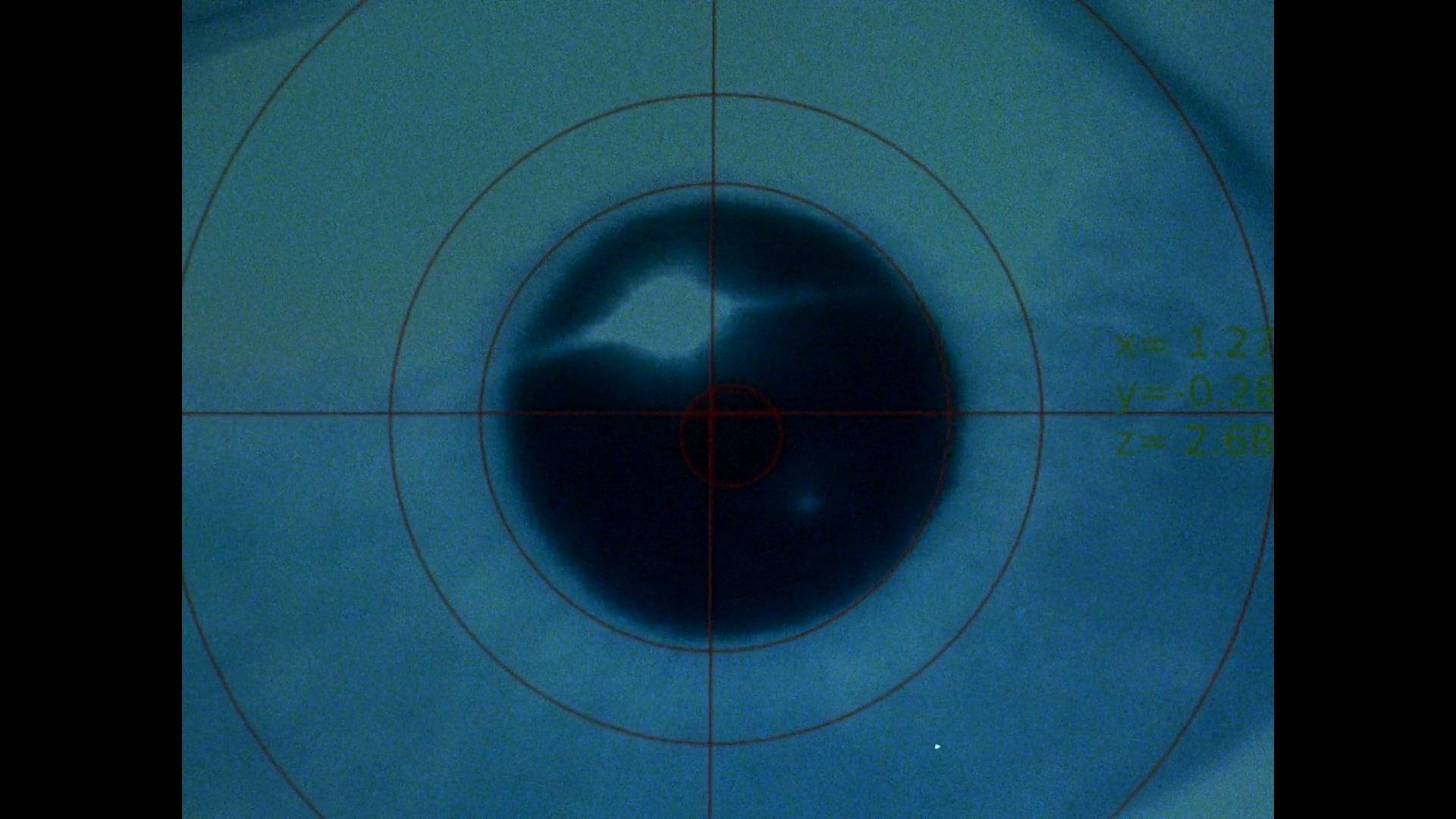
Both the eponymic film and the two moving image works that accompany it are marked by repetitions of previous works, by hauntings and ghosts. Shaky, handheld views track a walk up a craggy mountain path, echoing images in Amator (2019), a work composed as much of delegated footage shot by Ershadi’s mother, Azita Chegini, on a borrowed handycam as by her experience of filming on someone else’s behalf, of grappling with the camera as an "artificial limb" whose language she must learn. Striations of a sun flare in an expanse of blue sky foreshadow the blue-hued refraction of An eye, open (2026)—itself a recursive continuation of the 2023 two-channel installation, چشم چشمه , in which medical imaging of Azita’s eye and archival VHS recordings coalesce to entwine the corporeal fragility of both vision and memory. The latter source material—produced from the inadvertent layering in 1998 of broadcast footage and home movies of heavy winter snowfall—is further reworked in this iteration as a paratextual screen in the reading room, something akin to marginalia found in someone else’s library.
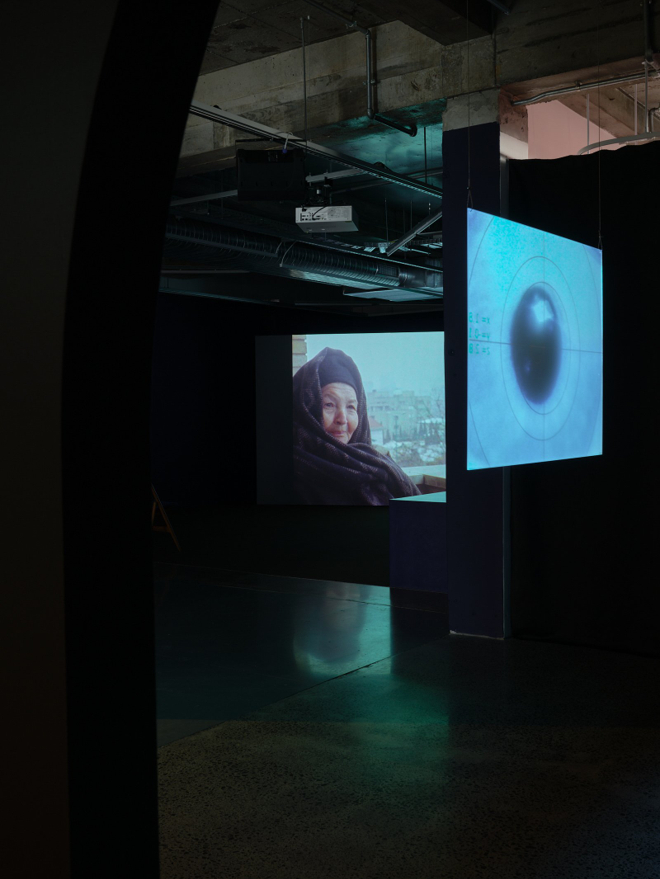
Installation view, Selina Ershadi, The Blue Dome, Artspace Aotearoa, Tāmaki Makaurau Auckland, 2026. Photo by Sam Hartnett.
In the exhibition’s accompanying literature, the blue dome is referred to variously as the night sky, a void, an aperture—and an eye. Yet to trace the cascading repetitions of Ershadi’s fugue explodes any notion of an authorial eye into multitudes—across her practice, the eye is made up of many different voices. Viewed through the iris of its proxy—the camera—what the eye can see proves insufficient, its narrative unstable. Alongside, aural and haptic experiences—indeterminate, opaque—attend to the irresolution of this perpetual unknowing. The Blue Dome might equally hinge upon the destabilisation of the eye, foregrounding instead embodied methodologies of touch, sound, and speech. Ershadi’s camera grazes her subjects with intimations of multi-sensory collapse: if the lens is a form of touch, the hands—and the ears—may also look. For passage (2026), a new audio work that both opens and closes the exhibition, Ershadi worked with artist and sound designer Frances Libeau to weave together field recordings from her trips to Tehran, a cassette tape of relatives talking in 1980, and the resonant space of the gallery itself, including feedback from Karangahape Road’s urban interference. The soundscape acts as a spatial-temporal co-presence to the durée of The Blue Dome—it is the same duration and was composed as a response to the sound and images in the film. Its effect, as threshold or curtain that separates the experience of the exhibition from the 'outside world', is one of disorientation, of doubling. The ticking clock’s orbital movement is a recurrent presence; the ear directs the eye.(6) Resisting audible legibility, the sound both is and is not—recalling the impossibility of "one is, one is not" that returns us to the fallibility of any one register of representation.

Selina Ershadi, The Blue Dome (2026), still. Co-commissioned by Artspace Aotearoa and the Queensland Art Gallery | Gallery of Modern Art. Courtesy the artist.
"The air is alive with messages. Messengers, angels," says Thomas, the aged mentor to Ben Lerner’s autofictional protagonist in his latest novel Transcription.(7) Similarly structured in three parts, the book’s principal narrative hinges upon its narrator’s failure to record what will be Thomas’s (a celebrated media historian and theorist) final published interview. There are affinities here with Ershadi’s own preoccupation with the promise of the apparatus versus the inherent subjectivity of narrative and fiction. Yet it is also Lerner’s attention to transcription as verb as well as noun that is prescient, the foregrounding of the role of a writer as the barometer of signals from the ether. As Thomas continues: "The question is: Do we have ears to hear? … There is listening beyond the cochlear, yes? And all of this is true of time, too, not only sound. Vibrations from the past or future may also be received, perhaps also through the teeth. Or through your pen, the poet as seismographer."(8)
The poetics of Ershadi’s practice are writ into the very fabric of this exhibition. It is, to draw on lines by translator Yasmine Seale found in one of the books she has gathered in the reading room, "a long poem, a counter-text vibrating in the margins, an effort to press the dream logic of nights into the narrative logic of ... days."(9) Its politics are woven with a light hand—an oblique, sideways glance at the very real insecurities at its core, as the gaps and voids of The Blue Dome—the black screens that might also be mirrors—find an analogue with all that cannot be said.(10)
In conversation, Ershadi points me to a marked page in another of the assembled publications—a poem by Romanian postwar writer, Paul Celan, from which this essay takes its epigraph. Its lines speak of vision and home, of fracture and loss; that pain might produce a kind of clarity. Through reticence of narrator, recorder, or interlocutor, the need for roots—the artist’s and others’, or our own—is left unresolved, and finds its truth not in answer but in longing.
Selina Ershadi: The Blue Dome was on view at Artspace Aotearoa in Tāmaki Makaurau Auckland from 25 April to 4 July 2026.