There is a preoccupation within Sonya Lacey’s latest exhibition that allows the show to cohere, but I wonder if there’s another route through it? As with so many of Lacey’s gambits the more you try to put your finger on its impulse the more it shifts. Her veiled content is always tactically just out of reach. There is a self-generating impulse that’s inherent within Lacey’s practice. Looking at her manifestations, her objects, it’s as though you encounter a very volatile genesis. It’s auto-propulsive, but it’s structurally so. Right from their inception. Which is to say, Lacey’s practice, for all its insistence on physical objects, is deeply conceptual, a rigour that’s through and through apparent in her Whangaeri show, Eveningness.
If we begin at the outset with the exhibition’s framework. Eveningness denotes a temporal location. It is usefully offset against morning, a preferred time zone. A normalised time of activation and activity. The early bird etc. Morning comes with preconditions. To sleep in is to indulge. Lazy bones. Eveningness then is somehow trapped between this polarization. Note too how eveningness is not the night owl hipness of the club-goers either. Recognise too how both these temporalisations carry associations, they’re environmental cues of affiliations or worse yet, temporal implications. They are habitual responses. To be trapped in eveningness then is to be confined to a certain behavioral mold. Sort of.
Think of how the monastery structures their day around the prayer cycle. Matins (morning), Lauds (mid-day), Vespers (evening). Each temporal moment carries a different focus. Matins is for reflection, Lauds for praise, Vespers for thanksgiving. The day passes through these structures, through these temporalisations, in a purposeful way. It is not merely by chance but an elaboration of the same circadian structure we inherit from the sun. The sun moves across the sky, the plants dutifully follow that arc, bending and swaying, contorting themselves to that rhythm. Just as the monks do. But what if we break that apart? What if we shift environments? Work the night shift. Live on the moon. What if we can’t distinguish this circadian rhythm as natural? What if it just doesn’t work? What was it like before Maui tamed the sun? Or in that preternatural zone before Tane cleaved his parents apart?
It’s not entirely clear then that eveningness is really what Lacey’s show is about. Sure it locates a temporalisation, and it helps she picks such a peculiar one. Just to roll the name around your tongue. It doesn’t sit naturally. Eveningness. It’s not even dusk. We all know dusk. Dusk is liminal, between dog and wolf. But eveningness is not dusk. It’s not a site of transformation but of static, of stasis. To be trapped in eveningness with no way out. Again perhaps? But then there are also a number of other factors at work in Lacey’s exhibition that point us elsewhere. Or at least she wants us to arrive at this temporal adjudication, only to take us further.
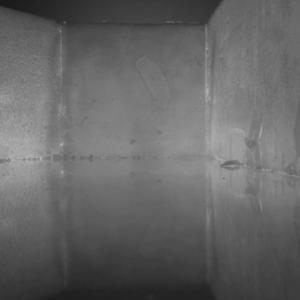
Perhaps that’s rather woolly. But Lacey’s title allows us to conceive of this temporalisation. It also allows her to think about and probe at time-isolation-units. These are methodical devices that allow the scientific study of a subject’s withdrawal from circadian bias. If we want to grow potatoes in space. If we want to know what happens to human sociality in confinement. If we want to think about how the effects of low-level radiation alter bodies. All such suppositions require us to isolate the subject, to withdraw the subject but also to enclose the subject. This is clearly the subject of a number of Lacey’s sculptures within the show. The first a copper lined airlock, that allows items to pass between subject and observer without breaking a hermetic seal. Lacey cleverly embeds this into the gallery’s partition wall. But it’s not entirely obvious. At first in seems like a kind of minimalist joke. The lined copper interior radiates a sacrosanct hue. It draws you in like the suitcase in Pulp Fiction (1994). It’s mesmerizing, literally so, but then you’re just met by this labyrinthine structure. A detour, a bend, or a zig zag that doesn’t compute. Just an empty box to put your head in. It’s only when you walk around to the other side and begin to notice how the external panels slide shut that you might think of it functioning as an air-lock, or as a dumb waiter. A transitory space between one zone and another.
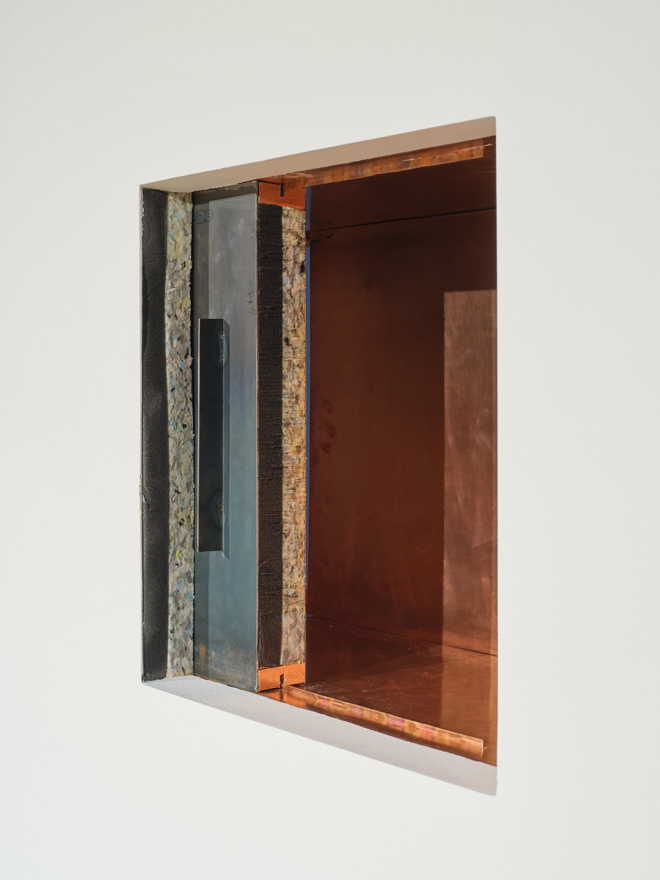
Sonya Lacey, Time Isolation Unit (passbox) (2026). Plywood, foam from recycled mattresses, sound baffles, mild steel, copper sheet. Installation view from Eveningness (2026) at Whangārei Art Museum (2026). Photo by Sam Hartnett.
The other sculptures to probe this imposition or temporalisation is Lacey’s John McCracken-esque plinths. Or wall partitions. These are about head height and body width in size. They’re imposing in that sense but they’re also obviously cross sectional. Diagrammatic exemplars. They’re cut through the middle exposing an interior that is a series of foam insulations and particle board sealed by intensely reflective copper sheets on one side and absorbent black wood on the other. It goes without saying then that these sculptures are dense and absorbent, porous and then contradictory reflective. Here the copper’s slick surface finds its corollary in the porous matte black, it sinks into the funk of the darkened gallery. Its granular too, textural in a charcoal smeared earthiness appeal. It’s a relief from the vertiginous copper, that sheen with no end. That plate that would run to the end of the world if we let it. No variation, no porosity. Just a surface to glide upon. Like McCracken’s sublime. You can see then how this dichotomy plays into the temporalisation of a withdrawn subject. What I’d like to call, following Giorgio Agamben, a practio-inert subject, if that wasn’t so politicised and contrary to what I think Lacey actually has in mind. For I don’t think Lacey’s interest in these time-isolation units is disciplinary. I think, like Pierre Huyghe, she finds a fascination in the biological limits of Terran environments. Something time-isolation units are designed to do.
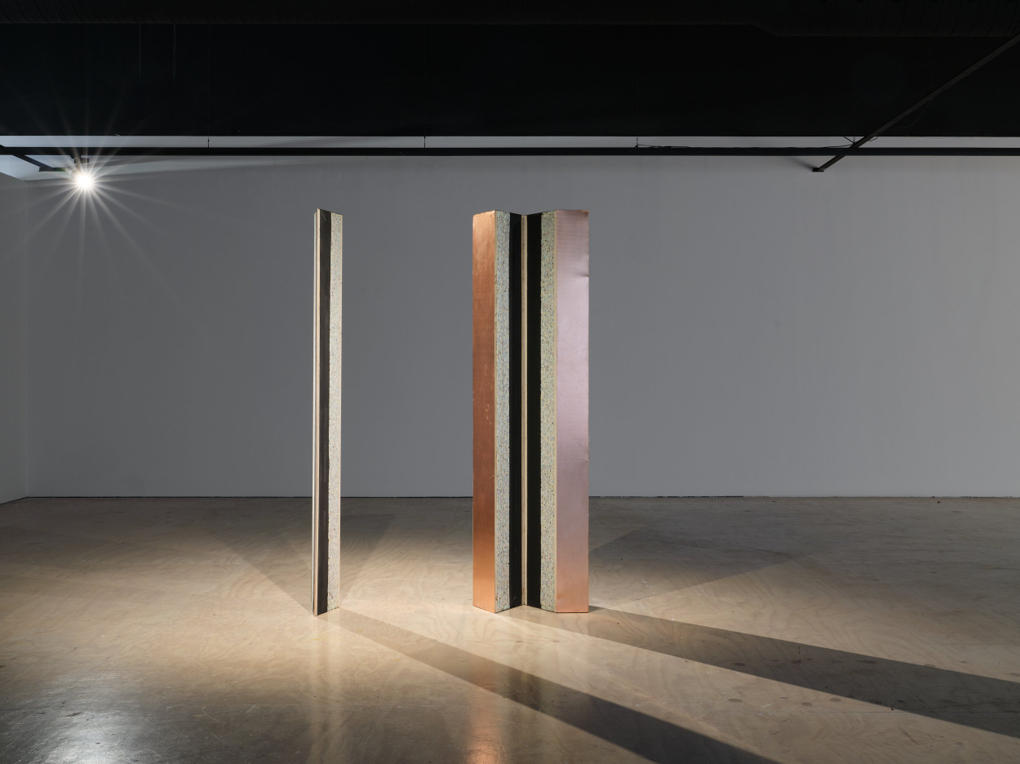
Time Isolation Unit (door mechanism) (2026). Plywood, foam from recycled mattresses, sound baffles,vmild steel, copper sheet, piano hinge. Installation view of Eveningness (2026) at Whangārei Art Museum (2026). Photo by Sam Hartnett.
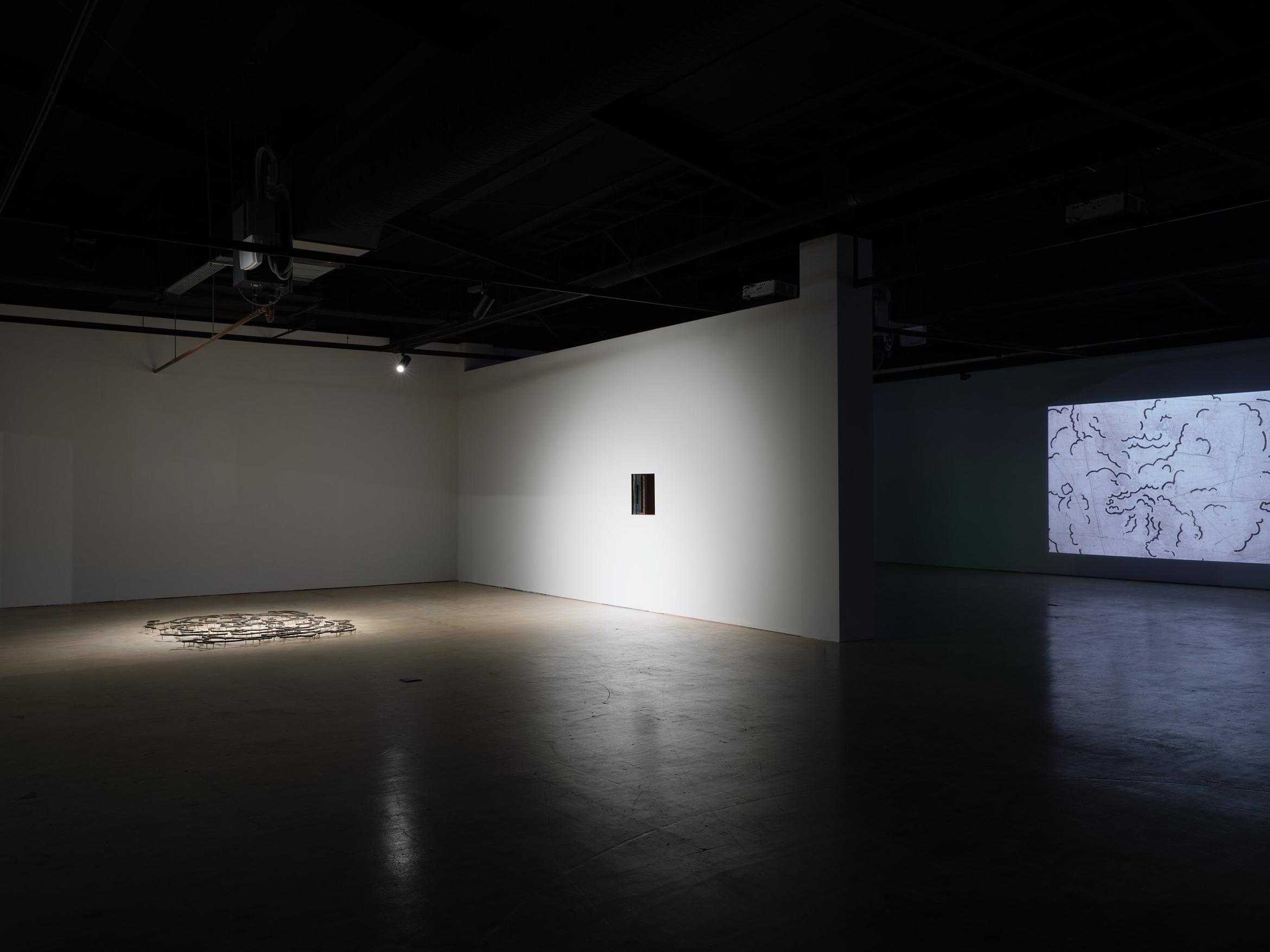
It’s easy to say that because of Lacey’s inclusion of short stop start animation film within the show. In fact, you might say it is the show’s centre piece. The gallery is darkened for it. It provides the light for the dumb-waiter to glow. Requires the partition for the airlock to even be placed there. For you to be standing there wondering what is this apparatus? But it’s also the centre-piece conceptually as well. The film glows. It’s iridescent. It’s again that copper reflection, that sublime luminosity so alien to the circadian impulse of the sun. Copper’s strength is to diffuse, it’s not porous. It’s not immediately reflexive. It doesn’t give back. In a way you might say it alienates, but it also insulates. Again digressions, but Lacey excels at these. She stretches our latitudinal comprehension. That’s a good thing.
Installation Documentation: Sonya Lacey, Eveningness (2026) Whangārei Art Museum (2026)
The animation is created from acid etched copper plates. The film is cloud like. A series of concentric arcs forming and reforming into attitudinal patterns. It’s both dreamlike and spleen-like. It’s convoluted and distorted as well as being entirely illusionary. At one stage you can be mesmerized by the cloud like formations indulging in pareidolia (finding familiar shapes in visual stimuli) or repulsed by the grotesqueness of the spleen, of the filtering, processing of junk. Both happen at once. Like the scratches and jumps of the stop-start animation. There’s a push and pull, a dwelling on the edge. The film traps you in a fugal state. In a state of suspension but also possibility. Are you indeed looking through the microscope at a petri dish? This is what I mean about the limits of biological life. Right when everything feels possible. At the start of the clinamen. Before the swoop, and queasily so. It’s all so indeterminate and yet fertile and fecund. Full of possibility. Lacey excels at the primeval.
The strange thing though is that the endless possibility of this petri dish is brought dramatically into relief by the floor sculpture behind the projection. Here again are the same concentric patterns. The same cloud-like arcs. Now earthly metal objects. They’ve clearly been cast, and again they look like copper. But it’s a sullied copper. A copper that isn’t reflective but porous and diffuse. It looks like they’ve been run through a printing press, like they’re ink stained remnants. They look forlorn, abandoned. They’ve been made static. Suddenly something that seemed so effervescent when mobile looks instead moribund, defunct, decommissioned. It is then a kind of companion piece, not a representative dichotomy, but the structural apparatus, the supporting player. A biological footprint per se. But it’s also radically manifest. Unlike the film, which is fleeting and temporal and momentary. The floor sculpture is permanent. Or permanent in a kind of way, for again Lacey pre-empts such consoldations a-prior by making the sculpture piece meal, like Richard Killeen’s assemblages, capable of being re-arranged as an endless variable multiple. So semi-permanent, but metaphorically mobile! Like any apparatus should. Recall here how a refrain fixes the terrain only momentary for it is always already carrying its next mobilization immanently within it. Such is the impulse of rhythm rather than the dictates of metre. Again a digression but an important point. Lacey’s parallel play here, from the petri dish to the apparatus that supports it, shows how comingled and hybrid and contingent life is. Everything has to line up, just not in a lineal fashion!
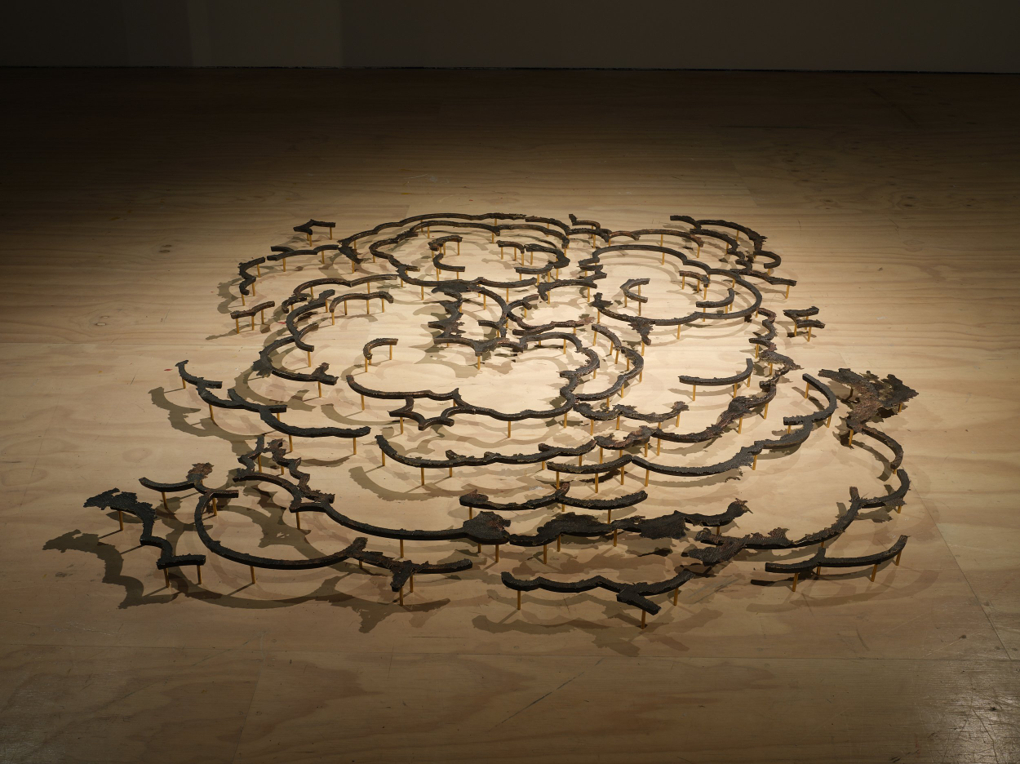
Sonya Lacey, Mattress (sleep-metal object) (2025). Cast iron, magnesium, copper and zinc, 1800x1500x50mm. Installation view of Eveningness (2026) at Whangārei Art Museum (2026). Photo by Sam Hartnett.
Which is an odd thing to say given the prints Lacey exhibits right at the entry to her show. A linear formation seemingly moving from left to right. That vector of mobility. But why not buy into a cliché from time to time. Life isn’t precluded by such limitations. This temporalisation, this fixation on metre, on rhythm as its antithesis isn’t one or the other. It’s always both! It’s the push and pull that get us there. There’s not rhythm without metre to develop it. Which is why the prints indulge in a few rhetorical elaborations, cliches perhaps but they grant the works a kind of mobility, a fleet-footedness, or a conceptual acuity that’s worth probing.
The images themselves are sponge like. Perhaps like marbled end papers. Whatever they are (and that indeterminacy in itself is the point) they’re speculative and absorbent. Like foam, or a viral pool, they’re moulds and molds, both prefigure a motility without cessation. They’re the emergent system of life, of bios. Of a vector that out-performs, that overcomes, adapts, transforms. This is why Lacey is so preoccupied with the staging of these images. She adapts a radical illusionism within the fragment. Not content just to leave the mesmerizing pattern alone, but to indent its supplication, to allow it a dimensionality by flecking out the bottoms with small rectangular cues. Are these fragments standing upright like Allen Curnow’s famous Moa?[2] Hardly, but the indication’s there. Just like the lineal line-up. The images seen to move left to right, they carry a sense of progression even though there’s none there. They’re not static, not isolated, but panned, run together like a radical enjambment of the primeval.
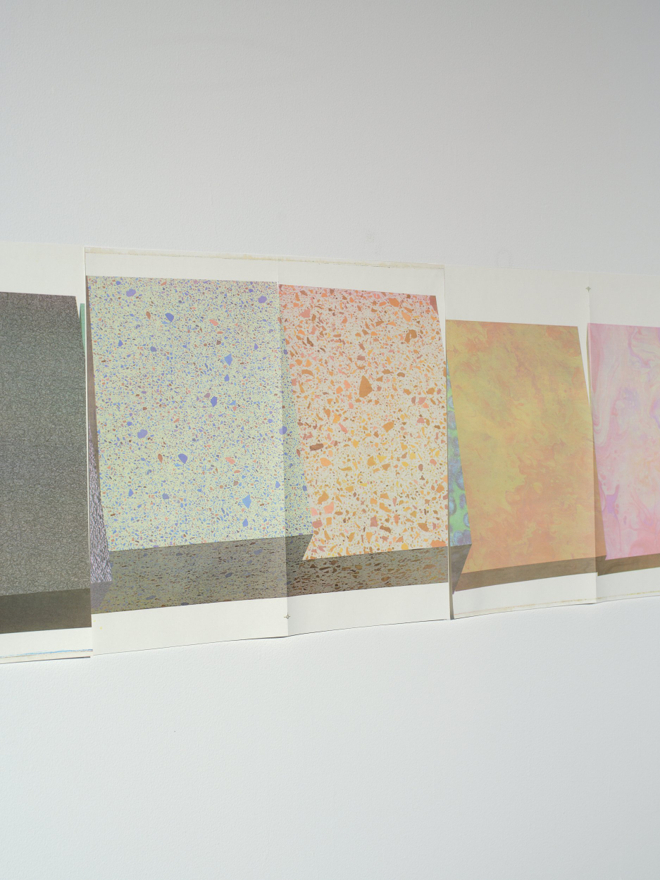
Sonya Lacey, Time Isolation Unit (flatplan) (2026). Hand-printed offset print. Installation view of Eveningness (2026) at Whangārei Art Museum (2026). Photo by Sam Hartnett.
But it’s never that simple! Lacey runs her prints across the fold. A deliberation so that you have a clear delineation of surface and yet the images slyly run across, jut and butt into one another. The little feet at the bottom make such distinctions even more blurry. One supports another like a blurring of apparatus and subject. Not that it shouldn’t be comingled, but nonetheless. And then what to make of the butterflying effect of the way the prints are hung. The bifurcation of the prints, the literal bend through the middle of the print, through the fold allows the prints to flutter off the wall. Like they’re taking flight or alert to the wind. I’m reminded here of poet Leigh Davis’ infamous exhortation to Willy whose looseness with the semiotic was always “blowing in the wind”.[3] That mobility, Willy’s prehensile willingness, to navigate the vagaries both big and small, the economic succubus, the ghost of Jim, the latest fashion, grants Davis’ poem a wonderful voluminous accommodation, updating what Walt Whitman did for the 19th century for 1980’s Aotearoa. My point here is that textual sublimation is always linked back to biological materialities, not to bio-political refrains, but that residual funk of life’s preternatural cadences to adapt and prolong, to keep going in the face of a multitude of viscosities or habituations.
“As clear as mud”, she said. And yes in a way. Lacey’s show is so porous of our hopes and dreams you can’t help but get entangled in it. From the soup of the indistinct evolution happens. This beating impulse with no cessation. Just forms. It’s at the extremes, at the structural limits that we begin to grasp this. Not the bio-political, or textual apparatus we wrap around it. The whole time I was in Lacey’s show I kept remembering John Cage’s recollection and horror at entering an anechoic chamber. Just when he thought he’d find silence he was overwhelmed by the noise of his own body, his own vibrations. The horror at the thought there’s no escape, no way out, but also the joy, the total discovery that there is no way out. No end in sight. Just an endless shifting refrain that moves with its own metre, just as it does in Lacey’s work. The structure might be the content but it finds no expression but in forms. That’s the strength of her work and it’s also why it so deliberately stretches our latitudinal cognition. We’re blessed to have it.