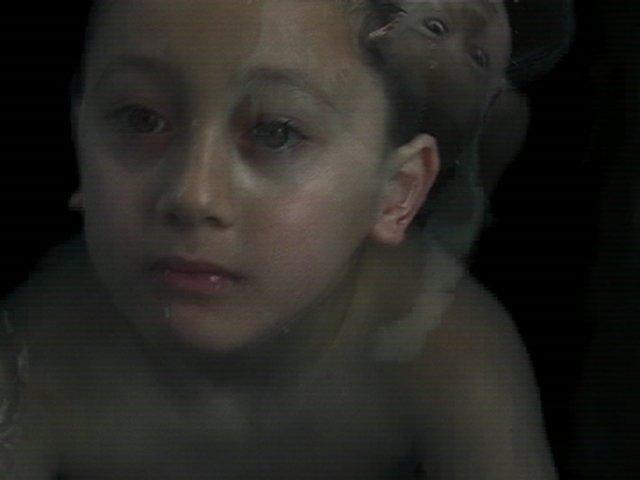
In looking with our mokopuna, we can see our generation; our lives, our collective character, the nature of our relationships, our accomplishments, and our mistakes.[1]
Ariki (2007) by Leilani Kake is a six-minute encounter of a young boy before he undergoes the Cook Islands haircutting ritual. The camera becomes a key witness in this intimate moment, allowing us to be present and involved in his anticipation. If this work were made by a less equipped artist, it could very well risk being ethnographic with its visual emphasis on the Indigenous body. However, because Leilani is the artist she is, she totally bypasses that risk by harnessing the power of sound, using it to extend the relational and temporal dimensions of the camera’s gaze. The presence of karakia and ‘īmene tuki transforms Ariki from a record of a Cook Island hair-cutting ceremony into a site where bodily, genealogical, and ancestral temporalities converge.
Ariki opens with the image of a rising moon, signalling that we are now roaming the realm of the never ending night, the realm of emptiness and pure potential. This is followed by a sequence of close-up shots of the young Ariki’s hair (played by Leilani’s son) and his waking eyes. The little Ariki slowly spins in the dark liquid expanse of te kore as if he’s still in the gestation period that precedes te ao mārama. His long hair snakes around him like eels while he maintains eye contact with the camera. Waiting, wading in the water, for the moment when he will be transformed.
Time moves differently here; videos of the boy are superimposed, layered, and reversed, allowing us to experience multiple versions of him at once. Perhaps he, too, feels fragmented in this moment. Perhaps he feels all versions of himself splinter and all strands of his whakapapa come alive. Perhaps he is aware of the cosmological and social transformation he is about to undergo, already mourning who he was.
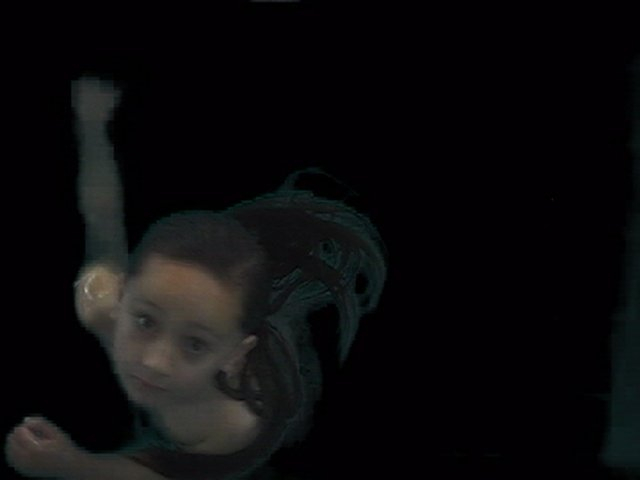
Leilani Kake, Ariki (2007)
French ethnographer Arnold Van Gennep identified three stages within rites of passage: separation, transition, and incorporation.[2] First the subject is separated from the collective, placed within a liminal holding state in which the transformation occurs, and is finally reincorporated into the social body, now having strengthened and solidified their social bonds. Ariki lies somewhere between separation and transition. He’s removed from the collective, but he is not yet transformed—he still has his hair. He occupies a kind of pre-liminal state, almost more liminal than liminal.What a charged place to be.
We realise this ritual is in action through the audio: the disembodied voices of tūpuna, family, and loved ones singing him into a new stage of life through a soaring cacophony of karakia and ‘īmene tuki. The sound of both reverberates and fills the entire space of the frame while being completely outside it, lifting the video from being a purely representational depiction of a young boy swimming, to a perpetually active ritual.
Like the other works I’ve written about in this series, Ariki could very well risk being an ethnographic film because it captures a young boy in the throes of a ritual. However, it entirely circumvents that through various technical elements of the work, namely the work’s formal relationship between sound and image. The little Ariki is presented as a singular body occupying the greatest visual weight of the work, but the audio is of multiple voices, generations, and islands. By contrasting the polyphonic sound of the collective with the singular body in a state of transition, we come to understand how the individual is incorporated into the collective and social body. But this must first be done by creating a ceremonial space.
The audio in Ariki functions as an acousmêtre, a sound whose source is unseen—it is omniscient, omnipotent, and ubiquitous, blurring the boundaries of the frame.[3] We never see the bodies of whom the voices belong to, but they are entirely present in the ritual, actively facilitating its happenings. The karakia, especially, brings the video’s ritual into action. This brings to mind the work of May Adadol Ingawanij’s curatorial project ‘Animistic Apparatus’, where she put together a series of public outdoor screenings as a means of inviting and addressing spirits. In an article summarising and reflecting on the project, she cites artist Zai Teng, “If we think of the cinema screen as a door between human and non-human worlds, what role might sound play in mediating its opening?”.[4] What sound is more sacred and more in tune with the spirit world than karakia and ‘īmene tuki?
I must confess: when I first watched Ariki I was confused by the presence of ‘īmene tuki because it’s choral music set to biblical texts. How had Christianity found its way into the deeply Indigenous and primordial realm of te kore? But Albert Wendt cautions us against a return to a “pre-papalagi Golden Age or utopian womb” which shows no scars of colonialism, the goal is a “new Oceania”.[5] Our new Oceania will indeed bear the scars because it’s a body in perpetual motion and state of becoming, much like our young Ariki. And so the ‘īmene tuki acknowledges our colonial histories without allowing it to become the only story of Indigenous cultural transformation. The form has been taken up, transformed, Indigenised, and made part of Cook Island life.
The tuki of the ‘īmene adds another interesting dimension to Ariki’s ceremonial space. Customarily performed by tāne, the tuki is a rhythmic ‘grunting’ that keeps the collective in time and brings dynamic movement to the ‘īmene. What does this mean in the context of this ritual where a young person is ‘becoming a man’ or even ‘becoming an Ariki’? What does this notion of masculinity as a structural thing mean? What does this implicate for a young person transitioning into manhood? To learn to be the beat? It’s certainly not an autonomous psychological transformation that occurs inside one person. By being situated within a sonic network of voices, relations, and obligations, our Ariki is made through his relations. And one day he will do the same for others.
Leilani Kake, Ariki (2007)
I watch this young boy in the moments leading up to his transition into manhood and wonder: who will you become? How will you deal with the weight of your legacy? Will you (like our Ariki) become a great beacon of power? Will you fall prey to the harmful ideologies of the manosphere? I would have been a similar age to Leilani’s son when this was filmed, if not younger. So when looking at this boy, I see myself and my generation; our strengths and wins, as well as our shortcomings and failures. Has all that we have done made a difference for our young people, our futures, and ourselves? But this little Ariki isn’t frozen in 2007, he’s an adult now, and all these questions have answers. So the artwork has accidentally—or maybe inevitably—become an archive of a future that hadn’t happened yet.
Leilani’s practice has by-and-large been characterised by an archival impulse. Especially in her earlier works, the camera is a witness to bodily transformations within families. Whether it be her father’s ascent to a rangatira and eventually te ao wairua in Tino Rangatira Tanga (2008), reflecting on Pacific women’s bodies and rates of cancer in Ngā Hau e Whā - The Four Winds (2011), the connecting of whakapapa through ritual acts of making in Talking Tivaevae (2005), or the mourning of rangatahi lost to abuse in Mata Ariki (2018). The suite of films Ariki belongs to is no different, each video documenting Leilani’s son’s development into a young man, culminating in The Hair Cutting (2011) which showed the actual ceremony of which Ariki is in anticipation of.
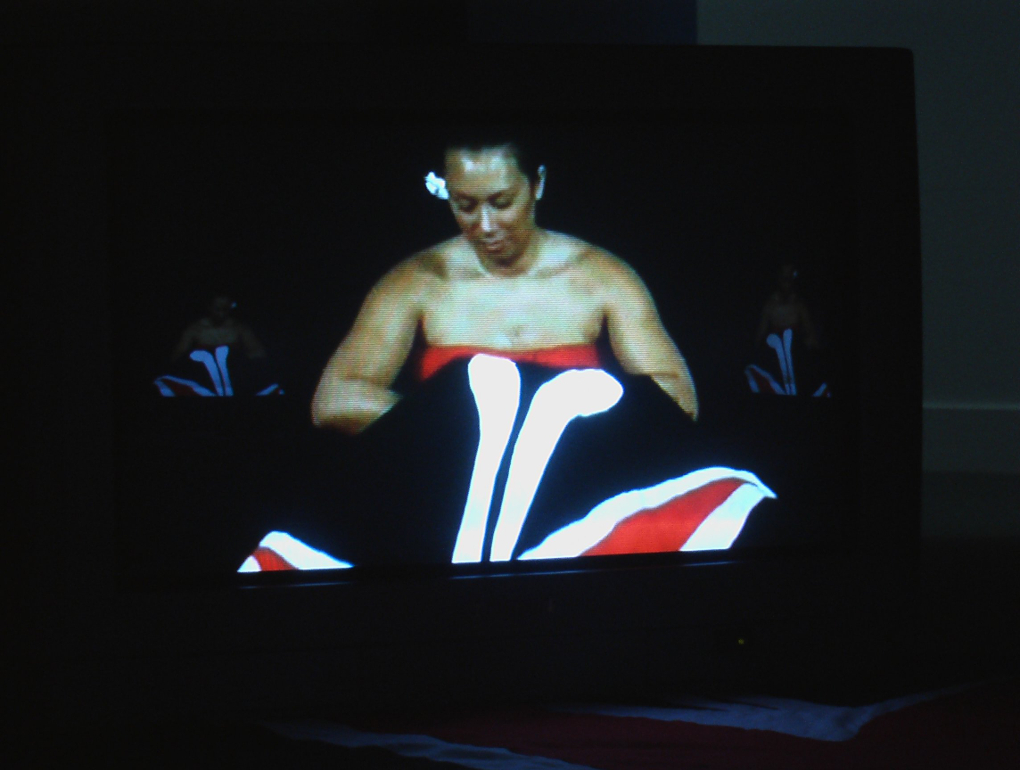
Leilani Kake, Talking Tivaevae (2005)
So much of what Leilani films is charged with a tapu; so much death, so much mamae, so much innocence. There’s a danger and risk in capturing these moments, which we’ve seen in more documentary modes of filming Indigenous peoples. But there’s something different about Leilani’s work. A different sort of tapu that doesn’t emerge from a filmmaker’s hara, it’s a tapu that already exists and will be alleviated through time and relationships, we just won’t be there to see it, because the noa is for the artist and her family. This form of ethical spectatorship and representation is in part enabled by her position behind the camera and her relationship to the people she videos. She is a mother, a daughter, a friend. The camera participates in a familial act of witnessing, much like witnessing your mother get old, your brother become a dad, your sister a teenager. Particularly in Ariki, the positioning of the camera is one of a mother’s gaze protecting from above, rather than a positioning meant to replicate hierarchy and dominance over a person. And placing her son in te kore makes it as though she is harnessing the realm’s collective power for her son.
When we look at the little Ariki we see the child, the future adult, the future ancestor, and ourselves as the generation responsible for what comes next. We look at this boy and we look through time, before and after us. By immortalising this moment of transition and vulnerability, Leilani creates a pou for us to return to when we have lost our footing and need to regroup, reflect, and remember. She reminds us of our responsibilities to mokopuna and community, that we must provide a network of care for them as they transition to different stages of their lives, that we might find strength and support from one another, our atua, and our tūpuna. But ultimately, to become great ancestors, we will have to nurture the young people.