When I e-met Latamai Katoa, I was cooking dinner for my flatmates while I had her talking from my laptop. It was a casual set up, honest to both our lives and schedules. We laughed and pondered while I cut up onions or fidgeted with the bottom of my hoodie and then (once I’d settled into the conversation) with the tape on my chest, hand under my hoodie. It was at that moment I saw a flashlight outside and realised someone was walking past my house. Did they see me? Were they watching the whole time, or were they just passing? If we had curtains in our kitchen I might’ve closed them to save what remnant of privacy I had, but the damage was already done; without realising I’d become a performer of my own life.
THE UNDERWORLD series (2024) consists of two moving-image works that use elements of theatre to interrogate the ethics of witnessing and the complexities of the gaze. Set at night in their backyard—at once a domestic and liminal space—Latamai stages a sequence of performances that oscillate between invitation and rejection. They relish in the sensuality of being seen, run from the camera, disappear behind a frosted bathroom window, and, at several moments, stare directly back at us.
Unlike the gallery, the backyard refuses to distinguish the audience from neighbour. Everyone becomes a witness whether invited or not.
As the performances unfold, one question quietly settles over everything: should we be watching this?
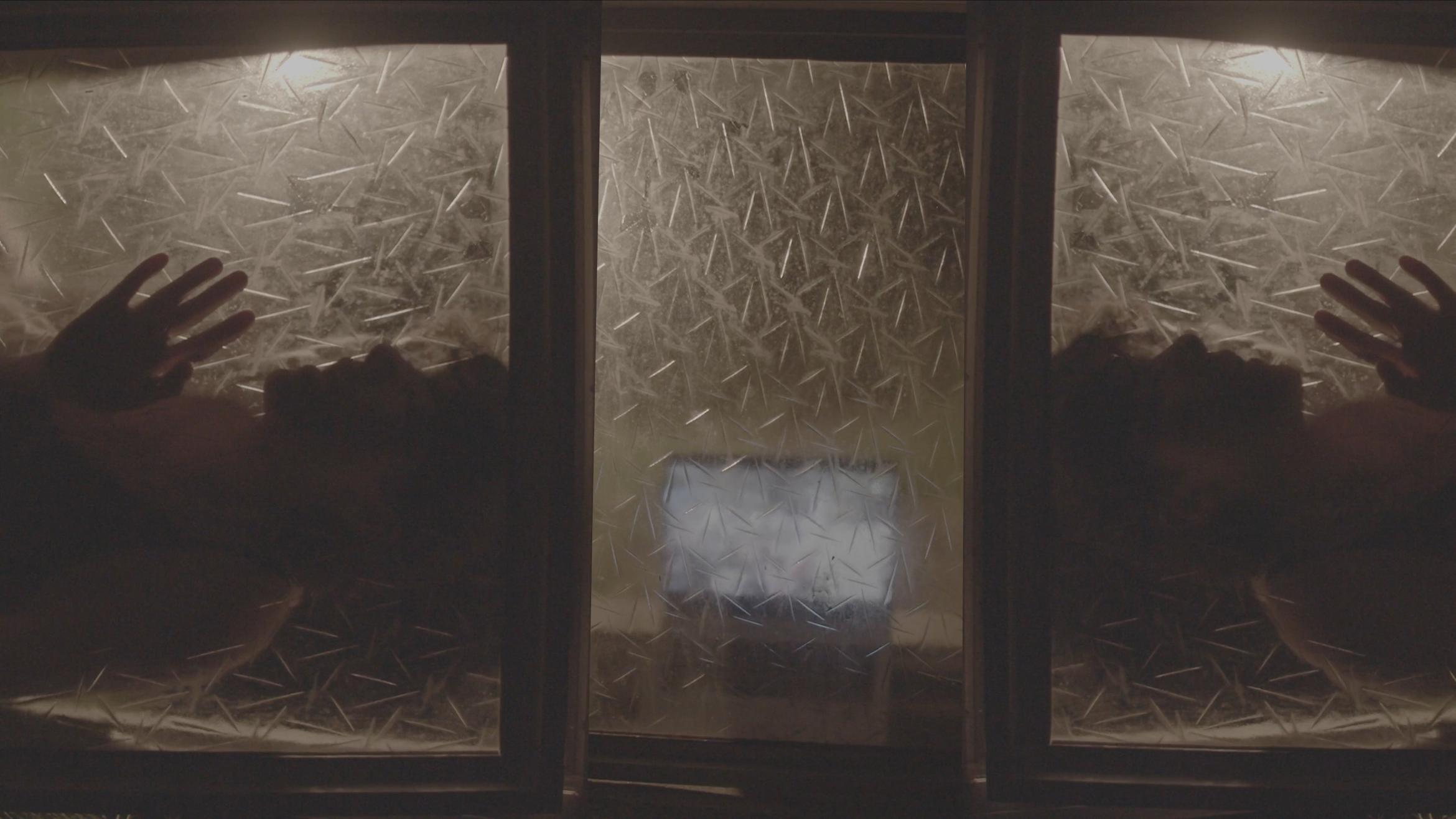
Part One opens with an over-the-shoulder shot of someone sitting on their bed watching footage from the 2023 Posie Parker protest on their laptop. Beside them is the book Miss Major Speaks: Conversations with a Black Trans Revolutionary. Then, abruptly, the laptop is relocated outside. We pan across the backyard where a frosted bathroom window has been propped upright and illuminated by a lamp. The window becomes another screen, or perhaps a third one. Sometimes we watch footage playing through it; other times we watch Latamai, obscured behind the frosted glass, kissing it, caressing it or, as they put it, making love to the bathroom window. Again: should we be watching this? The choreography between body, screen and window intensifies as images double, triple and quadruple. Latamai curls into a ball inside the frame, looking somewhere beyond us before quietly switching off the light.
The final scene reads like the packing down of a theatre show. In their open garage, Latamai scuttles around a parked car while the laptop rests on its hood, pop music drifting through the space. They carry away the window, sniffling, puffing; perhaps exhausted from the performance. They put on their coat and, while maintaining eye contact, close the garage door. Curtains.
Latamai Katoa, THE UNDERWORLD PART 1 (2024)
Part Two opens with two title cards: MASCULINE in red and FEMININE in blue. The camera reveals a new stage, this one occupied by two windows, and we hear Penny Wolfgram’s voice saying: “Betwixt and between. Both masculine and feminine”.[1]
The performance section alternates between two figures we’ll call Red and Blue. Red revels in visibility. Bathed in crimson light, she poses for an unseen horde of paparazzi: a hand on a hip here, a pout there, all while awkwardly contorting herself around a frame stripped of its canvas. She seems comfortable being a spectacle, but that assumption is complicated by the returning shadow behind the window.
Where Red courts visibility, Blue rejects it. Blue’s discomfort at being watched is first realised with an audio recording where a friend tells Latamai their art is bullshit, a reminder that once something is made public it becomes open to judgement. Blue repeats Red’s gestures but behind the protection of the frosted window, performing a striptease. Penny Wolfgram returns, this time explaining that “The caretaker of the spiritual world is actually a God and a Goddess,” a reference to the Tongan deity Hikule’o.
The work concludes with the title THE UNDERWORLD split between red and blue, collapsing the earlier gendered titlecards. Back in the backyard, the windows remain, now subtly divided by colour. Red continues posing while Blue runs in from behind and knocks one of the windows to the ground. Red continues posing while Blue knocks one of the windows to the ground before running, attempting to escape this farce yet remaining directionless and immobile. Finally, the image shifts to monochrome, where Latamai appears doubled. One buttons up her shirt and walks away. The other remains, hands folded, meeting our gaze.
Latamai Katoa, THE UNDERWORLD PART 2 (2024)
THE UNDERWORLD series is a masterclass on collapsing mediums and genres while maintaining a steady grip on the issues explored. Latamai’s use of moving image, theatre, and performance (all mediums which rely on a gaze-based optics) bolsters and deepens her exploration of visibility and witnessing. These issues are then made increasingly complex by the work’s primary prop (the frosted bathroom window) which is used to either obscure the body or emphasises its nakedness—an object that either highlights the agency of the performer to protect themselves, or the lack thereof. And here’s where I think Latamai is at her best: by refusing the assumption that visibility is inherently emancipatory. Instead of positioning THE UNDERWORLD in the, at times, one-dimensional space of representation politics, it asks a different question: how do we react to being watched? And then: what kind of access do we believe we’re entitled to?
For a while now, queer dreamings of liberation have positioned visibility as the goal. Yet, as Miss Major reminds us, “With all the visibility we’ve gotten—or should I say a few of us have gotten—over the past couple of years, it hasn’t done shit for most of the community.”[1] And, in some cases, increased visibility has proven to do more harm than good. Latamai’s work is painfully aware of this, never going so far as to show how hypervisibility manifests as violence, only allowing the possibility of danger to linger throughout the work; standing in front of a car, referencing TERFs like Posie Parker, being semi-naked in the semi-public space of the backyard. There are times while watching THE UNDERWORLD that I worry for Latamai, scared about what’s going to happen next despite knowing the ending. But the window becomes the object of refuge and relief, protecting the tapu of her body over and over again. No wonder she makes love to it. As a Mā’ohi I find it interesting, too, that the etchings in the window look like bird’s feet, because we consider birds to be shadows of the gods.
Is there a god protecting you here, e hoa? If so, should I look away? Or is that all the more reason to pay attention to what you’re showing me?
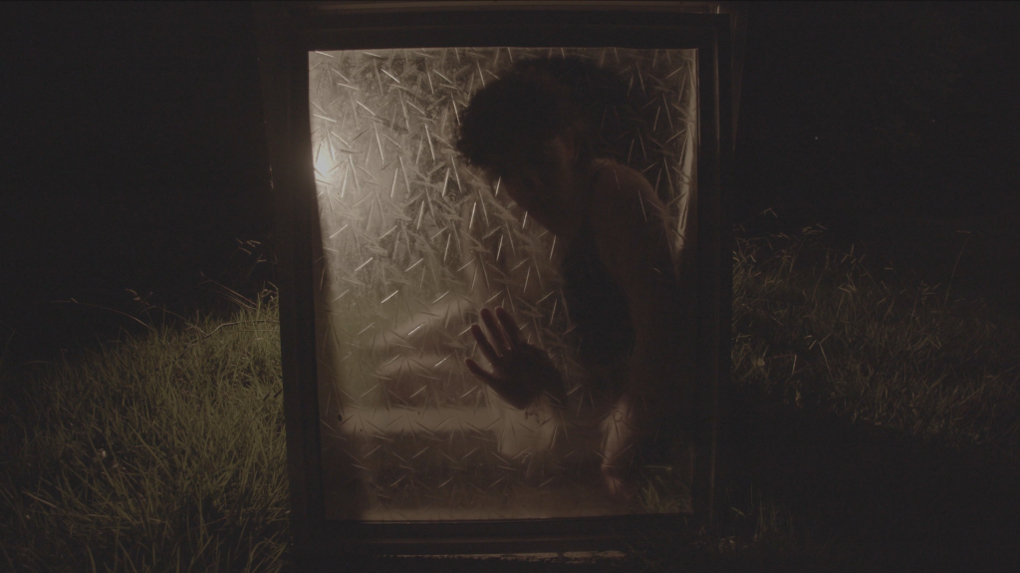
Latamai Katoa, THE UNDERWORLD PART 1 (2024)
Across the Pacific, understandings of gender have been predominantly labour-based. Those of us who occupy the special third option of betwixt and between have often taken on special responsibilities within our respective cultures as imaginers, knowledge-holders, critics, and stewards. And perhaps it’s precisely because of our in-betweenness that we take on this role of ‘imaginer’ because of our ability to see and embody the beyond. In the context of THE UNDERWORLD, we see Latamai stepping outside gender’s fixed co-ordinates and into the gloriously liminal space of te pō to perform a sort of cosmic drama, thus activating a cultural role to critique the social conditions we find ourselves in; to point to the sore spots in hopes for better treatment.
When talking about concealing and withholding information from the viewer, Latamai said they often like to ‘cosplay pretentiousness’ in their mahi because the display and use of highbrow or esoteric knowledge is often considered only for those who are upperclass and/or Pākehā. Because of their determination to reclaim pretentiousness, there are certain references in THE UNDERWORLD that go untranslated and need prior knowledge to understand. Good. Clarity should be collaborative or privileged information. Furthermore, when we think of esoteric knowledge in Indigenous spaces, you’ll find the reasoning is often to do with safeguarding. On one hand it’s to prevent misuse and appropriation, and on the other hand it’s to protect the tapu of that knowledge. Because practices like tapa, tatau, and ’ōrero involve communing with spirits (at least in te ao Mā’ohi), there are certain guidelines on how you conduct yourself in those spaces so as to be in good relation with the spirits involved.
I’m reminded of the Siovili and Mamaia cults in Samoa and Tahiti, respectively.[3]They were reactionary religious cults that arose from the increasing missionary presence in the 18th-19th century, and sought to blend Christian beliefs with Indigenous beliefs. In both, prophets would offer up their bodies as vessels to spirits to speak through and deliver messages to the people. If THE UNDERWORLD is indeed pulotu or te pō, then perhaps Latamai is a spirit coming forth to communicate some vital message from the beyond. They are testing us, seeing how we will react and how we will respond.
This is all to say that THE UNDERWORLD sits within ancient Pacific traditions of dramatic performance as a means of subverting and deconstructing social realities, which is then amplified through the medium of moving image. If a performance like this were to be captured a few decades ago, it might’ve been an ethnographic documentary filmed by Pākehā. But because of the leaps and bounds made by the forerunners of decolonising the screen (thank you Merata Mita), Pasifika creatives like Latamai are able to re-imagine this historically loaded medium.[4] Instead of the flatness and purported objectivity of the camera, we get an interdimensional experience that is perhaps a closer realisation of what our ancestors imagined for their performances; a peephole into te pō where objects gain sentience as protective taonga and spirits are evoked to provide wisdom.
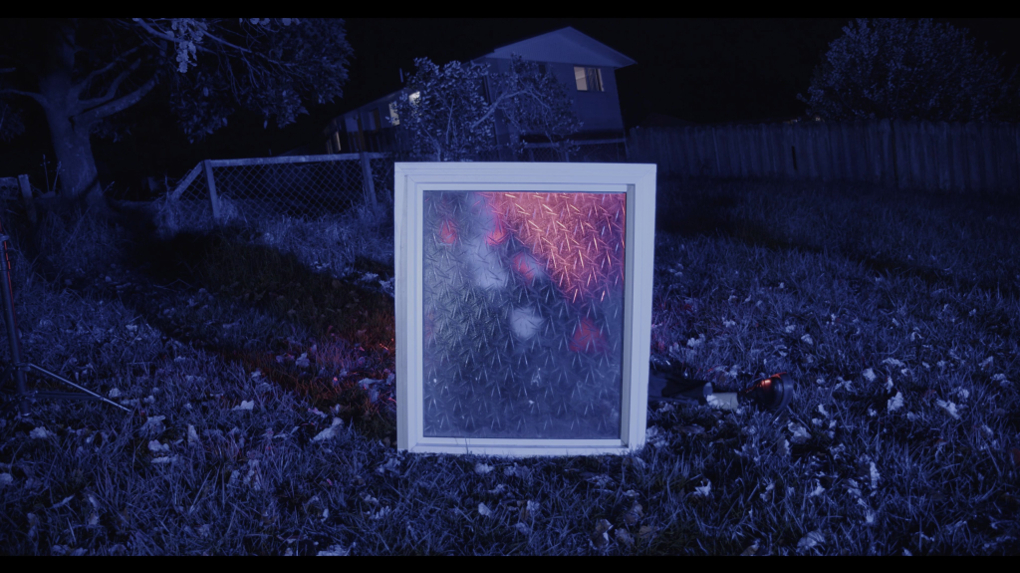
Latamai Katoa, THE UNDERWORLD PART 2 (2024)
When I look into this peephole and see Latamai framed by the window, I’m struck by the thought that this is the contemporary Leitī Dusky Maiden determining exactly how her body is encountered. Here, she chooses whether she will delight in the spotlight while aware of its dangers, or if she refuses it altogether. Above all, the access to her body is on her terms, made possible by the moving image medium. That feels especially significant when so many of our tūpuna were denied the opportunity to choose how they present themselves. So when I see this Leitī Dusky Maiden in te pō, I imagine a deep-time healing is taking place by doing what our tūpuna could not.
THE UNDERWORLD doesn’t ask us whether brown trans people should be seen. It asks: under what conditions, by whom, and at whose invitation.
We’re reminded that opacity is an ethical condition of visibility. That privacy can be protective. That rejection can be loving. And that the right not to be fully known is just as sacred as the desire to be witnessed.
When I think back to that night in my kitchen, I wonder if I’d gotten over the initial fright of being caught in the act of living, would I have indeed drawn the curtains? Or would I have put on the performance of a lifetime like Latamai?