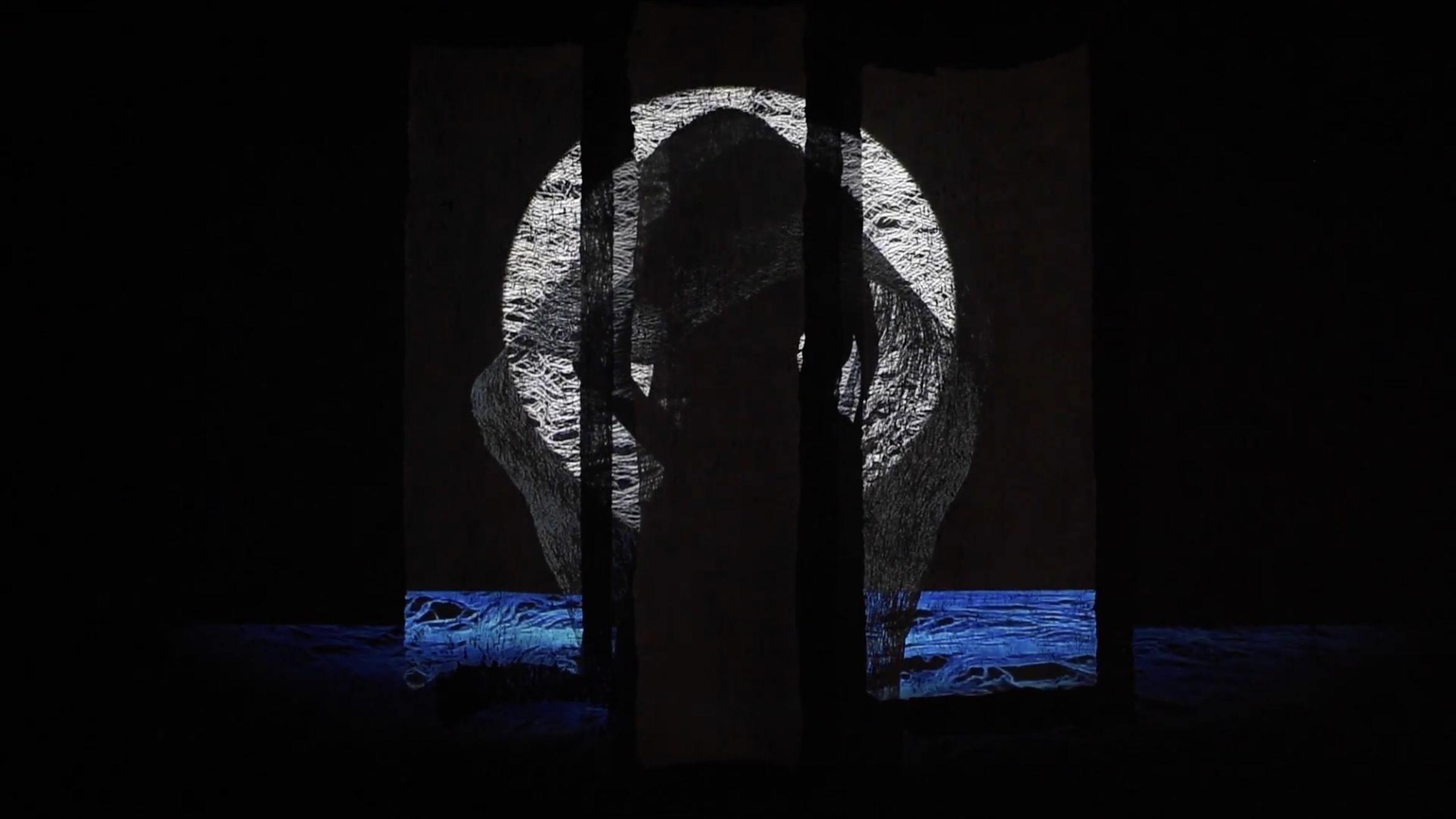
Hina’s Granddaughters (2022) is a ten-minute film composed of live-action, animation, song, and narration. Conceived as an installation, it’s projected onto panels of tapa where performers embody Hina and the twelve Mā’ohi women of the Bounty. Rather than treating the screen as a neutral surface, the work uses the projection screen as a portal through which whakapapa is activated across generations and realms.
The title of this essay comes from another question, one Norf’k elder Edie Christian asked some thirty odd years ago during a weaving circle. These weaving circles often involved long conversations about history and culture: how our story became sensationalised by history books and Hollywood, how we became known as the offspring of brave mutineers seeking freedom and adventure … and Tahitian women. Then, one time, Edie spoke the proverbial words that would ultimately shape the trajectory of Sue and Pauline’s practice, as well as my own: Watabaut dem wahine orn aa Baunti? What about those women on the Bounty?
Hina’s Granddaughters emerged during the COVID lockdowns of 2020. Pauline (my Mum), living on Anaiwan country in Australia, and Sue (my Aunty), in Whakatāne, found themselves separated not only from their sons in Hawai‘i and Tahiti but also from their homelands. They spoke with each other on the phone for hours each day, working through the pain of physical distance from home and the spiritual distance from atua and tūpuna. COVID had intensified an already colonial condition of separation, but through those daily conversations they began imagining another way of relating across distance.
Filming began in 2022 when I moved to Aotearoa for university and Mum and I reunited with Sue and her daughter for the first time since the pandemic. Pauline and Sue dressed us up in tapa and pareu, enlisted their sons to contribute recordings and materials, and transformed it all into an immersive moving image work brought to life through tapa.
Pearson and Reynolds, Hina's Granddaughters (2022). Whakatāne Museum and Arts
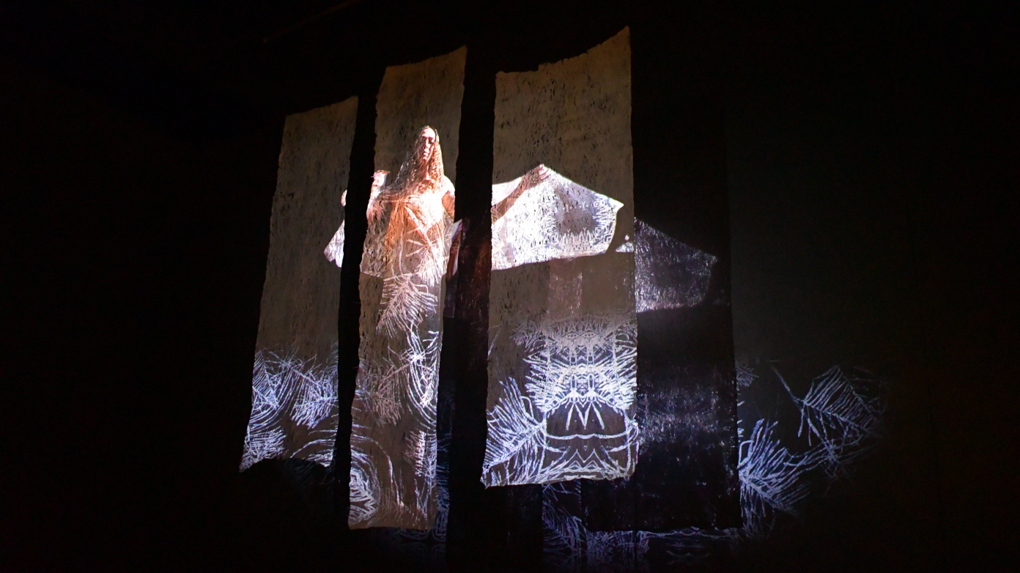
The resulting work uses moving image as a portal into te pō, where we’re able to commune with tūpuna. This portal is realised through the installation, with the film projected onto three panels of tapa made from aute grown in Sue’s backyard in her old home in Whakatāne. Projection screens are often imagined as neutral surfaces that exist purely as a receptacle for images, but tapa refuses that neutrality. Before a single frame is even projected, the tapa screen already carries genealogy, labour, and memory. It is itself an archive of ancestral knowledge: grown, stripped, soaked, beaten, dried, marked. And when moving image is projected onto tapa, the screen transforms from being a passive object into an active participant.
The transformation from neutrality to participation is significant because tapa has often been treated as a docile or agentless object, in part because it’s been regarded as women’s work. But in this work, it is a living surface through which our tūpuna wāhine are encountered on their own terms. I am in awe of my Mum and Aunty for taking a material that’s been the site of so much historical mamae for Indigenous peoples and turning it on its head, reimagining the screen as something uniquely Pacific. In doing so, the work asks us to think differently about what film can do. It moves beyond its capacity as a representational and almost ethnographic medium to something akin to ceremony. Projection becomes invocation, narration becomes incantation, and watching becomes participation in an unfolding relationship with tūpuna.
Pearson and Reynolds, Hina's Granddaughters (2022) (Documentation excerpt), Whakatāne Museum and Arts (2022).
Hina’s Granddaughters begins how all tapa begins: with a full moon raised above glistening waters and the patron saint of tapa, Hina. The deity’s silhouette (played by Ruby Kalahikiola Amelia Clark, Sue’s daughter) appears before us with her arms outstretched and draped in tapa, and we hear the faint sound of the vivo in the background (played by Oihanu Manari’i Reynolds-Fa’ara, Pauline’s son and my brother). Hina then begins her story (narrated and written by Pauline), telling us she’s sometimes lonely on the moon, but the Gods and the many generations that precede her keep her company. From her spot in the cosmos she watches over her descendants and she hopes that you (the viewer, assumed to be a mo’opuna) will continue to make ’ahu (the Tahitian word for tapa) like the many generations before.
The animation — particularly in the opening section — draws its imagery directly from Hina’s narrative, as though she is conjuring the world before us from te pō. In that sense, it sits within broader traditions of Pacific digital art that draws its visual language from the imaginary, the ancestral, and the underworld. Animator Mike Bridgeman alchemises the imagery Sue provided into a tangible expression of Hina’s memory and imagination, as though her speech is generating the world in real time.
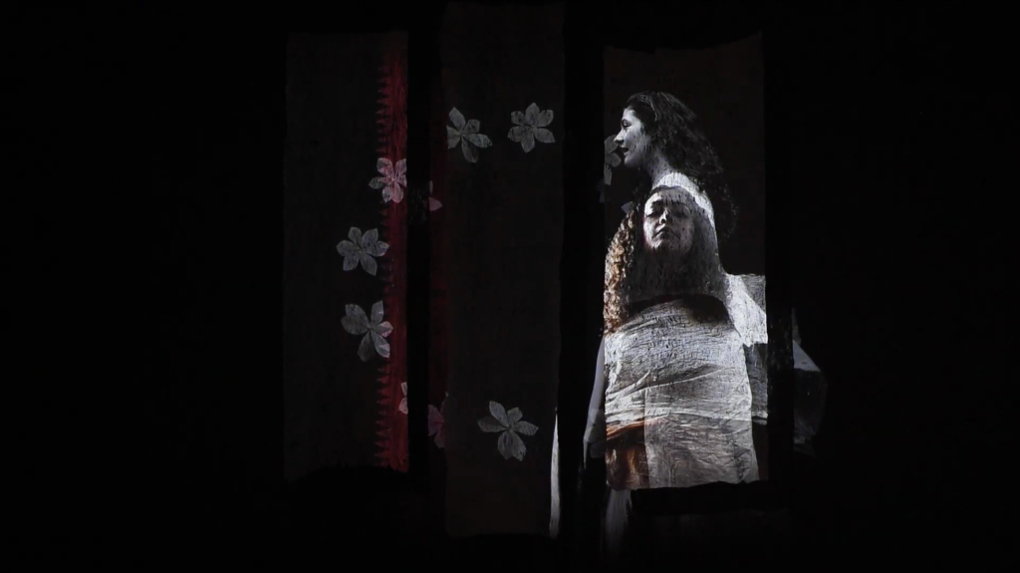
At the centre of the work is an act of naming. Pauline composed a song that I perform in the second section, calling forth each of the twelve Mā’ohi women:
Mauatua (aka Maimiti)
Te’ehuteatuaonoa (aka To’imata)
To’ofaiti (aka Hutia and Puni)
Fa’ahotu
Teraura (aka Mataohu and Taoupiti)
Teatuahitia’a (aka Te Rahu and To’imata)
Vahineatua (aka Parahaiti and Pate)
Mareva
Tevarua
Puara’i
Teio
Tinafanaea (aka Tohoromata)
Pearson and Reynolds, Hina's Granddaughters (2022). Whakatāne Museum and Arts
Each time a wāhine’s name is sung, she gets her own designated screentime, adorned with a hei of twelve tiare tahiti and a serrated rectangle of burgundy tapa, reminiscent of the shoulder band layered onto Pitcairn tīputa which provided structural integrity to the garment. The tīputa (similar to a poncho) were emblems of high status in the Mā’ohi cosmological hierarchy of which all the women inherited as daughters of chiefs or high-borns.
It’s also important to note the significance of incantation in te ao Mā’ohi. We believe the great God Ta’aroa spoke our universe into being by calling forth every imaginable natural body from the void and into the world of the light. I like to think a similar thing happens when descendants speak their ancestors’ names. By speaking the names of your ancestors you bring them into being. And each time one of these wāhine is sung into the work, she ceases to be an anonymous ‘woman of the Bounty’ and instead becomes an individual with a story.
Perhaps this is what the moving image makes possible. By indulging in an auto-biographical act of projecting a piece of our internal world into the external, we reignite the parts of our ancestors that lie dormant within us so they might linger in te ao mārama a little longer. The same could be said of Hina, the guiding force of the work. Through Pauline’s narration and Ruby’s embodiment, both descendants become visibly and audibly entangled with the atua, collapsing any neat distinction between ancestor and descendant. It’s significant, too, that the relationships present in the work extend beyond the screen. Pauline and Sue’s collaborators aren’t drawn from an anonymous production crew but from their own family ties: the sons and daughters of the artists are the actors, musicians, photographers, and makers. The film is made genealogically. Whakapapa is both its subject and its method.
I was recently listening to Orators Anonymous—a podcast by Coco Solid, Falesā ‘Mush’ Iosefo, and Manu Vaea—and they brought up the concept of retrocausality: the idea that what we do in the present impacts our past. What healing we do, heals our tūpuna. And I thought, that’s just it! I recognised the idea immediately because it described exactly what I’d been seeing throughout Hina’s Granddaughters. Pauline and Sue reject colonial narratives and abandon any sense of linearity. In doing so, the work suggests that descendants remain in active relationships with those who came before us. Every act of remembering, singing, weaving, making tapa, and filming becomes an intervention into the past as much as an intervention into the present. Thus retrocausality isn’t just a high-falutin abstract concept; it’s also an Indigenous praxis that relies on collective remembrance and creation to repair our relationships with each other and our ancestors.
If the colonial project’s imperative is to separate and isolate Indigenous peoples, isn’t the best counter to come together? Despite their flaws, communication and film technologies have enabled Indigenous peoples across the world to band together and rekindle long lost relationships. I admit it’s ironic that the very technologies once used to document, categorise, and exoticise Indigenous peoples have become tools for our resurgence. But we must remember that these technologies aren’t inherently liberatory, because what transforms them is the mahi enacted through it. In the case of Sue and Pauline, we see how they repurpose these modern technologies (e.g. screens, phones, digital archives, and projection) to build bridges across oceans, generations, and realms.
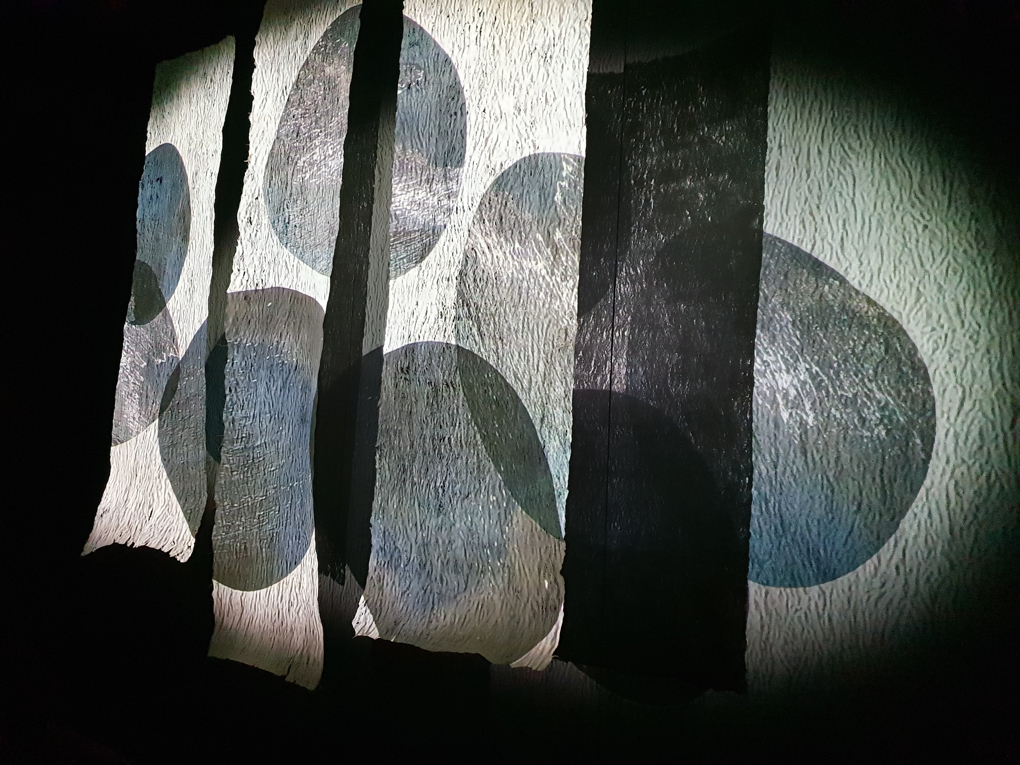
The final section (which isn’t included in the extract on this website) plays like a doting grandmother teaching you about tapa. Hina now alternates between English, Norf’k, and Tahitian in her instructions: never take more than you need, hetei dem e’e f maeken ’ taapa, ’ua ’ūa’a te tiare. She ends by saying “You are a grandmother’s dream”. Meanwhile we get a series of visuals of stripped aute stewing in water, someone beating a length of tapa, and dried tapa being smoothed by stones (provided by John Kaleimakali’i Thornton Clark, Sue’s son).
There’s a level of didacticism in this part that reinforces the viewer being assumed as a mo’opuna. Here, everyone is a child of Hina. Here, everyone is a child of the Pacific. Here, everyone is welcome to learn tapa. There is no interest in excluding you or leaving you behind because we will not be repeating the mistakes of the historians, artists, and filmmakers of yesteryear.
Pearson and Reynolds, Hina's Granddaughters (2022).Whakatāne Museum and Arts
Hina’s Granddaughters has now shown across both motu of Aotearoa, as well as in Tahiti, Hawai‘i, Norfolk Island, and on a cruise ship sailing towards Pitcairn. But it’s funny that the film keeps finding its way back here to Aotearoa. When I asked Mum and Sue about the role Aotearoa played in the film’s lifecycle, Sue said she felt it was an extension of the story of Rū and Hina. Before her final journey to the moon, Hina ventured with her brother all across Te Moana Nui a Kiwa, from Tahiti to Aotearoa to Hawai‘i. It’s interesting then that the film has been shown at almost every corner of the Polynesian triangle, mirroring the trajectory of Hina’s journey (next screening on the moon? TBC). In a more tangible sense, Aotearoa was the place in which Hina’s Granddaughters was made possible, through both community and institutional support. Much like how the soil in Whakatāne nourished the aute used for the installation, Aotearoa nourished the development of the work and continues to do so, through me being given the opportunity to bring Hina’s Granddaughters back into the conversation of how Pasifika artists are repairing their relationship to moving image and forging a new legacy of film-making.
To think that all this discovery and reconnection emerged from asking one question! Which leads me to think, what other questions are waiting to be asked? What other ancestors and Gods are waiting to be unearthed? What relationships can we reawaken by reclaiming the screen?